Get Full Government Meeting Transcripts, Videos, & Alerts Forever!
Get email alerts on the Rezoning 700 Edge Road topic
No spam. Unsubscribe anytime.
Council approves rezoning at 700 Edge Road for light‑industrial warehouse, adds traffic and local‑hire conditions
Summary
The council voted 4–1 to rezone 700 Edge Road from commercial (C‑2) to industrial low density (I‑1) for a proposed ~278,000‑sq‑ft light‑industrial warehouse, subject to staff conditions (site plan conformity, safety, road restriping/resurfacing and screening) plus a requirement that the developer conduct locally focused hiring outreach and complete road work before certificate of occupancy.
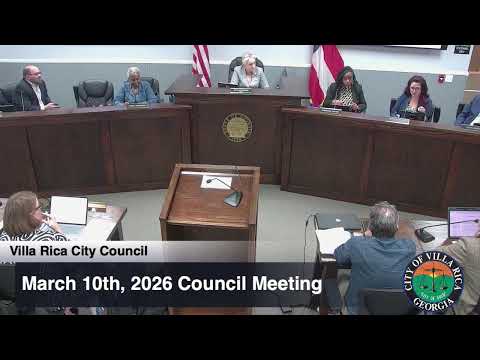
After a lengthy public hearing and staff presentation, the Villa Rica City Council on March 10 approved a rezoning that allows a roughly 278,000‑square‑foot light‑industrial warehouse at 700 Edge Road.
Staff described the project as a transportation‑logistics facility sited just south of I‑20; the developer and their engineers agreed to a package of roadway improvements intended to reduce queue spillback at the Liberty Road/Edge Road intersection. Those improvements include extending the southbound left‑turn lane to provide approximately 188 feet of storage with a 100‑foot taper and resurfacing and restriping portions of the intersection. Planning staff recommended approval with five conditions covering building, fire, screening and roadway requirements; the council added a condition requiring the restriping/resurfacing be complete before a certificate of occupancy and another condition asking end users to make "commercially reasonable nondiscriminatory efforts" to recruit Villa Rica residents.
Applicant representatives noted the site’s history and market realities: attorney Joe Fowler told the council a comparable retail development would generate many more daily trips (more than 10,000 daily trips in one modeling example) while a light‑industrial logistics use at the scale proposed would generate far fewer daily trips (the applicant's figures showed roughly 336 daily trips) and would concentrate truck traffic in off‑peak hours. The developer estimated the project could support roughly 175–250 permanent jobs depending on end users.
Council members raised traffic and sewer‑capacity questions. Councilwoman Conte (Ward 5) pressed staff and the applicant on whether the parcel could be used as currently zoned for commercial retail, and whether the nearby road network can sustainably handle additional truck traffic following the recent Peach State Freight development. Staff said the applicant’s traffic impact study, plus subsequent turn‑lane analysis and coordination with GDOT, supported the proposed restriping and repaving; staff and the applicant agreed to the restriping/resurfacing and to an on‑site septic system until sewer capacity becomes available, at which point the developer must connect (18‑month window once the city deems capacity available).
The motion to approve the rezoning passed 4–1. The approval is conditioned on conformance with the submitted site plan, incorporation of any city‑engineer roadway modifications into final construction plans, completion of the restriping/resurfacing prior to certificate of occupancy, appropriate screening for bay doors (subject to design review), and a local‑hire outreach commitment from end users.
Why it matters: The project is one of the largest developments recently considered by the council; it will change land use along the I‑20 corridor, add jobs, and require coordinated traffic and utilities mitigation. The council’s conditions aim to reduce near‑term traffic impacts while preserving future utility connections.
What's next: The developer will proceed with plan submittals and permitting; staff will verify roadway design and final screening as part of plan review and the land‑disturbance/CO process.