Governor's 2026 education budget proposes student‑safety and assessment reforms while raising Blue Ribbon Commission savings target, drawing pushback
Loading...
Summary
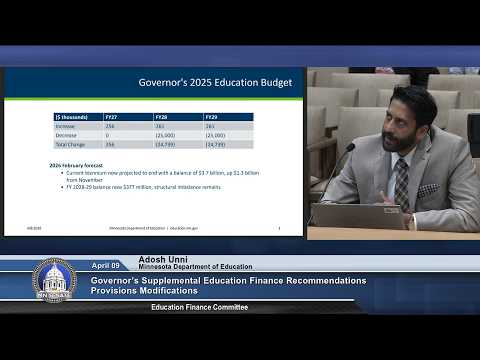
The governor’s 2026 K‑12 budget presented a mix of student‑safety investments, assessment reform, and administrative changes—plus a proposal to increase the Blue Ribbon Commission’s special‑education reduction target from $250M to $300M—that prompted sustained objections from senators and educators.
Commissioner Willie Jett and Minnesota Department of Education staff walked the Senate Finance Committee through the governor’s 2026 education finance proposal on April 9, outlining investments in student safety, assessment redesign and technical changes across K‑12 programs while drawing sharp concern over proposed special‑education reductions.
The proposal funds a statewide student support intervention and resource-team (SSIRT) model and requests a dedicated specialist to support implementation. MDE staff said the package includes modest increases in fiscal 2027–29 for student‑safety work and a multi‑year task force (two years, modest funding) to reimagine statewide student assessments.
A higher‑profile element of the presentation was a contingency the governor proposed for the state to redirect nonpublic pupil aid and nonpublic pupil transportation aid to voluntary pre‑K should a future administration opt into a federal voucher program; MDE staff said the governor has stated he will not opt in, but the contingency would redirect savings toward pre‑K expansion if opt‑in occurred. MDE estimated that redirecting those aids could add about 7,000 voluntary pre‑K seats and produce tens of millions in savings in the near biennia.
The presentation also recommended technical fixes including revisions to the literacy incentive aid formula (moving away from MCA proficiency/growth to concentration factors based on English‑learner and poverty concentrations), timeline fixes for attendance pilots and gender‑neutral restroom grants, and allowing Compass to provide guidance on educational technology and artificial intelligence to districts.
Most contentious was the governor’s proposal to raise the Blue Ribbon Commission’s special‑education reduction target from $250 million to $300 million in the 2028‑29 period. Multiple senators and members of the Blue Ribbon Commission said the added $50 million is unrealistic and warned that repeated cuts would shift costs to local districts and weaken supports for students with disabilities. School administrators and special‑education directors testified that prior reductions already create substantial local cross‑subsidy pressure; district witnesses said additional reductions would force programmatic cuts and increased local levies.
Senators also debated whether MDE’s proposed expansion of an Office of Inspector General’s authority should be embedded inside the agency or handled through an independent statewide OIG; several committee members urged that any inspector‑general function be independent from the commissioner.
On the use of artificial intelligence in schools, sponsor legislators pushed for stronger statutory guardrails beyond guidance, expressing concern about student privacy and data collection by private companies; MDE staff said Compass will offer best practices and the department is open to more prescriptive language.
MDE committed to follow up on technical legal questions raised during Q&A (for example, whether the state can lawfully cancel specified nonpublic aid programs in response to federal action) and to provide requested analyses on civics funding and other items.
Next steps: Committee members took testimony from multiple stakeholders and scheduled further hearings; no committee vote was taken on the governor’s proposal itself.