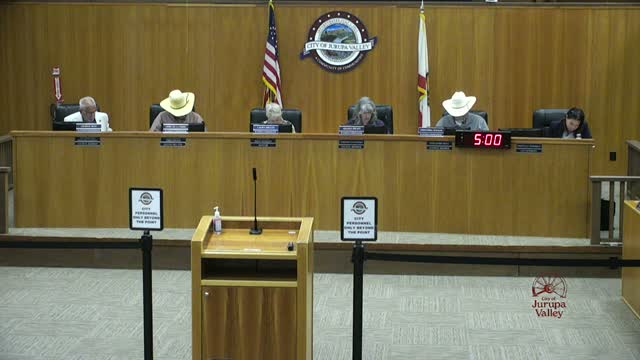
Jurupa Valley planning commission continues hearing on Queen of Hearts riding academy over fence and setback issues
Loading...
Summary
The commission continued a public hearing on MA24059, a community benefit permit and variances for Queen of Hearts at 6405 Dana Avenue, after detailed staff presentations and widespread public support. Commissioners asked staff and engineering to research options for a fence encroaching into the public right‑of‑way and continued the item to May 13, voting 5–0.
The Jurupa Valley Planning Commission on the evening of the public hearing continued consideration of a community benefit permit (MA24059) and related variances for Queen of Hearts, a therapeutic riding academy at 6405 Dana Avenue, after commissioners requested additional information about a fence encroaching into the public right‑of‑way and the practical impact of required setbacks.
Senior Planner Renee Aguilar told the commission the proposal seeks a community benefit permit to authorize Queen of Hearts, and variances to allow existing accessory structures and animals within required rear and side yard setbacks and parking that does not meet the city’s standard driveway/approach clearance. "The required entitlements tonight are both a community benefit permit to allow a riding academy known as Queen of Hearts, and a variance requesting structures to encroach within the required rear and side yard setbacks," Aguilar said during the staff presentation. She said the site is in the city’s equestrian overlay, the nonprofit-operated program is primarily supported through fees, grants and fundraising, and staff determined the project is categorically exempt under the CEQA Guidelines, Section 15301 (Existing Facilities), Class 1.
The applicant, who spoke on behalf of Queen of Hearts, described a long-running therapeutic program that serves children and adults with developmental and physical disabilities, veterans and school groups. The applicant said the program has existed on the property for many years and that moving fencing or shifting structures would reduce the usable arena area and create financial hardship. "If we make it smaller, that would be difficult to do," the applicant said, explaining the arena helps clients develop gait and balance and that some clients and volunteers rely on the space for therapy.
A central point of contention was a vinyl (block) fence along 64th Street that city engineering determined encroaches into the public right‑of‑way. Staff advised the fence would typically need to be moved off the right‑of‑way, and engineering indicated a setback of roughly 8 feet could be required. Commissioners and the applicant flagged that moving the fence that distance would substantially reduce arena dimensions, could displace large‑vehicle access for deliveries and risk program viability unless a financial solution or legal mechanism to allow the encroachment is found.
The commission also examined parking and driveway standards. Aguilar said the applicable development standards include a three‑foot requirement from property lines for parking stalls and a 30‑foot standard measured from driveway approaches intended to prevent vehicles reversing into the street. The applicant said typical sessions involve two clients (rarely three) and therefore a small number of vehicles on site; the operation has one ADA‑accessible stall and uses a porta‑potty maintained weekly while exploring how permanent restroom requirements would affect the site.
Public comment was strongly in favor of the proposal. Staff recorded 23 public comments in the file and said 22 letters supported the project and one letter opposed. Families, volunteers and veterans described the program’s benefits: "The Queen of Hearts was the place that helped me transition back into the community," said Sergeant Major Gregory Coker (ret.), who credited the program with supporting veterans’ rehabilitation. A parent who uses the service described it as "very well structured," and several volunteers and neighbors urged the commission to consider ways to preserve the operation while meeting public‑safety and right‑of‑way obligations.
Commissioners said they wanted to limit burdens wherever possible — in particular, several commissioners agreed to take proposed conditions regarding lighting and permanent restrooms off the table for now while staff researches alternatives — and asked the city attorney and engineering staff to explore whether a legal mechanism, indemnity, easement or other approach might allow the fence or other encroachments to remain without exposing the city to increased liability. Staff agreed to return with additional information.
Commissioner (speaker 3) moved to continue the public hearing to May 13 and request additional information; the motion was seconded and carried unanimously, 5–0. The item will return with a supplemental staff presentation addressing the fence/right‑of‑way options, clarifications on required findings for the community benefit permit and proposed conditions to include or exclude restroom and lighting requirements. Speakers who testified on April 13 were entered into the record and would not be required to return for the continued hearing.
Next steps: staff will consult engineering and the city attorney, prepare recommended resolution language and return to the Planning Commission on May 13 for additional deliberation and a potential vote on a resolution of approval or denial.