Get Full Government Meeting Transcripts, Videos, & Alerts Forever!
Get email alerts on the Community Revival topic
No spam. Unsubscribe anytime.
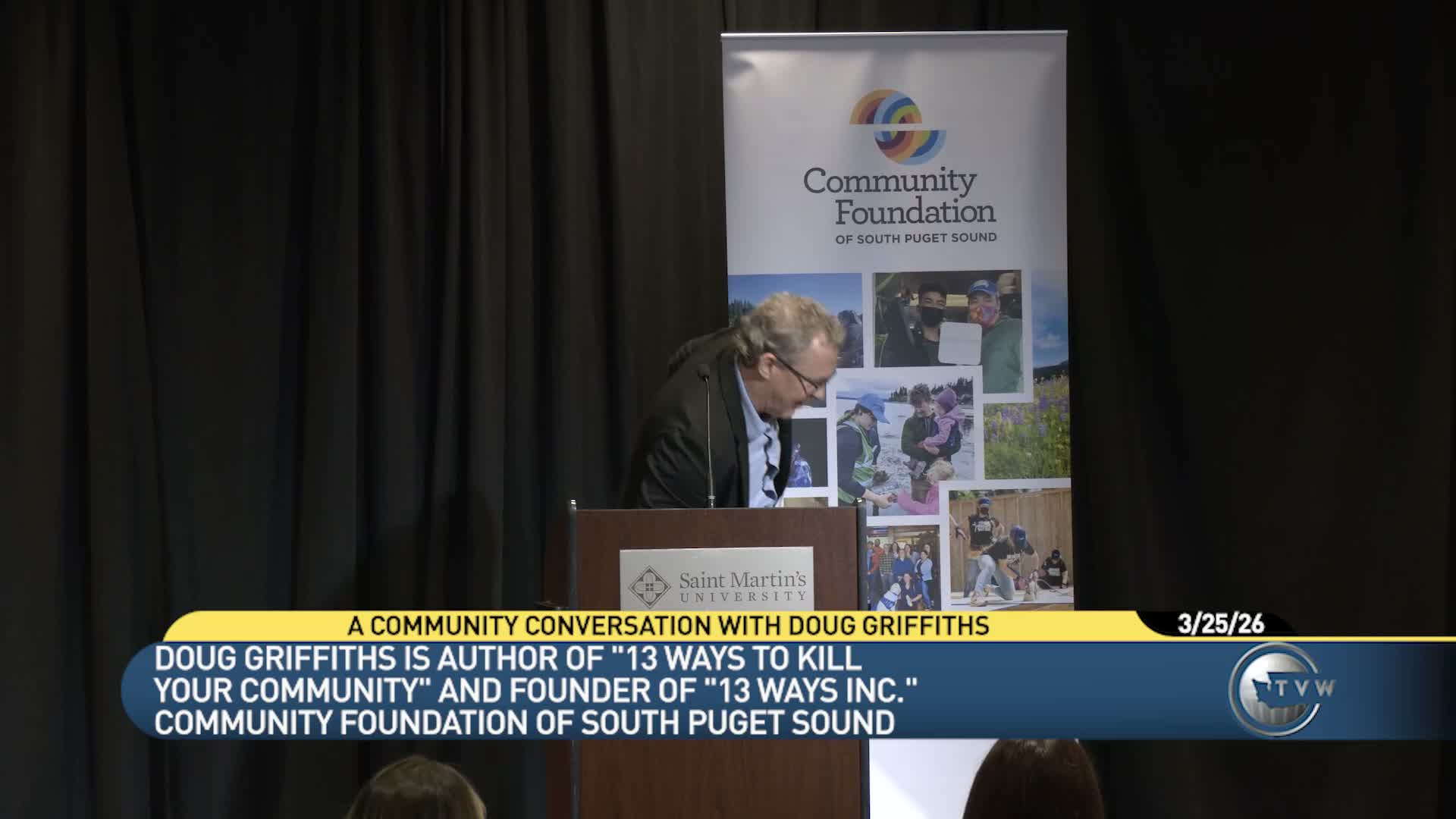
Doug Griffiths urges community-led 'renaissance' to revive Main Streets and engage youth
Summary
At a Community Foundation of South Puget Sound event in Olympia, Doug Griffiths, former Alberta legislator and author, called for resident-led local action to rebuild downtowns, expand small-business entrepreneurship and give youth real authority — not just consultation — while fielding audience questions about funding, gentrification, homelessness and accessibility.
Doug Griffiths, a former Alberta legislator and author of 13 Ways to Kill Your Community, told an Olympia audience at a Community Foundation of South Puget Sound event that communities must stop ‘‘trading away’’ their futures and instead lead local revivals through small, resident-driven actions.
Griffiths opened by recounting a provincial report he wrote with 72 recommendations spanning health, education, infrastructure and housing and said that communities often know the fixes but repeatedly choose easier short-term options. "We did this to ourselves," he said, urging communities to acknowledge uncomfortable local truths before trying to rebuild.
Why it matters: Griffiths argued that downtowns are the engine for broader community health — and that aesthetics, programmed social experiences and locally owned businesses attract investment and visitors. He pointed to concrete tactics: coordinated marketing, co‑location of complementary businesses, small-scale beautification and volunteer-led projects that can replace or leverage large grants.
On funding and gentrification: When an audience member asked "where's the money gonna come from?" and raised the risk of gentrification displacing longtime residents, Griffiths replied that funding often follows demonstrated local engagement. "Money will come when you get people motivated," he said, and recommended a ‘‘two-list’’ exercise — convening local influencers to list what makes a place great and what can be fixed, then prioritizing simple, doable actions rather than waiting for external grants.
Housing and homelessness: In response to questions about affordable housing and the unhoused, Griffiths cited business–community collaborations he saw in Edmonton that developed small transitional units and connected social services with housing. He also referenced a Nordic (Denmark) model that keeps people safely housed while underlying causes are addressed.
Inclusion and accessibility: An attendee noted that some Main Street projects have worsened access for people with disabilities. Griffiths said inclusiveness must be intentionally designed into projects and suggested exclusion is often the product of oversight or ignorance rather than malice.
Youth engagement and local authority: Griffiths urged moving beyond token consultation toward granting young people responsibility and small budgets to lead projects. "Ask them what the problems are, what they think solutions are, and give them what they need to fix them," he said, describing three levels of engagement and recommending repeated, sustained outreach until youth participation becomes genuine.
Examples and evidence: Throughout the talk Griffiths offered multiple case studies — small Ontario towns that pooled modest resources to market tourism; Alberta communities that co‑located complementary retailers; and a local example where adding a daycare to a school bond unlocked housing and economic development — to illustrate how targeted, often low-cost actions produced measurable local gains.
Closing and next steps: Griffiths closed by urging attendees to act locally rather than wait for higher levels of government. The program ended with a brief book‑signing and a reminder from the Community Foundation that Project Connect mini-grants are open for applications.
Speakers quoted and attributed in this article are drawn from the event transcript and the speaker list compiled by the foundation staff: Doug Griffiths (speaker) and audience questioners identified in the transcript.