Get Full Government Meeting Transcripts, Videos, & Alerts Forever!
Get email alerts on the Homelessness Encampments topic
No spam. Unsubscribe anytime.
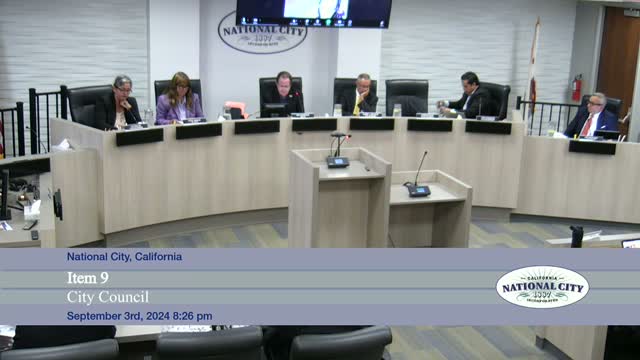
National City council introduces ordinance to restrict camping in sensitive public areas
Summary
After staff briefings on rising encampments and related public-safety impacts, the council voted to introduce an ordinance that would prohibit camping in locations the city deems immediate threats or sensitive zones and directed staff to continue outreach and request state funding to expand services.
The National City Council voted unanimously to introduce an ordinance that would prohibit unauthorized camping on public property where an encampment poses an immediate threat to health or safety and in specified sensitive locations, including within two blocks of schools, waterways and transit hubs.
City Manager Carlos Aguirre and staff framed the measure as a narrow enforcement tool coupled with expanded outreach and housing efforts. Aguirre said the proposed ordinance is intended to protect "the health and safety of all people in National City" and to align local policy with the governor's Executive Order 1-24 and the U.S. Supreme Court decision overturning the Ninth Circuit's Grants Pass ruling.
Kiana Williamson, the HOME team outreach coordinator, told the council the city is managing a rising count of people experiencing homelessness and described the team's work to connect people to shelter and housing. "We have registered clients and have housed 35 people since May," Williamson said, while noting many people remain service-resistant and that long-term housing options are limited.
Police and fire department officials summarized operational impacts. Police Chief Alex Hernandez said officers have recorded thousands of calls for service in recent years where homelessness was noted in the narrative and that the HOME team both self-initiates outreach and responds to dispatched requests. The fire chief described frequent vegetation and structure fires tied to encampments and warned of the strain on emergency resources.
Residents and business owners told the council about safety concerns and quality-of-life impacts. Susan Meyer, a pregnant resident, said encampments near her building have led to broken fences, late-night wanderers and at least one frightening overnight incident; she told the council she supported the proposed ordinance as one of several needed tools.
Several councilmembers emphasized a dual approach: use the ordinance selectively to address dangerous sites while expanding funding and services. Councilmember [Molina] (first referenced on the record as a voting member during the meeting) said the city must apply the tool narrowly and continue investments in outreach, temporary housing vouchers and coordinated case management.
City staff said the ordinance itself does not create new funding but will be paired with grant applications (including an Encampment Resolution Funding opportunity and opioid-settlement monies) to expand interim housing, case management and medical detox capacity. Councilmembers asked staff to return with additional data on outreach outcomes, storage practices for seized personal effects, and timelines for any planned RFPs for clinical detox beds.
The vote this evening was to introduce the ordinance for consideration; a later meeting will be scheduled for final adoption following additional briefings and any technical edits requested by council. The public hearing was closed before introduction, and the council’s action was procedural at this stage.