Lifetime Citizen Portal Access — AI Briefings, Alerts & Unlimited Follows
Legal Aid attorney outlines common fair-housing violations and local help at Carlsbad Housing Commission
Loading...
Summary
Amalia Romero of the Legal Aid Society of San Diego told the Carlsbad Housing Commission on April 9 that disability-accommodation denials, tenant‑screening practices and assistance-animal barriers are among the most common fair-housing problems; Legal Aid described enforcement options and local services.
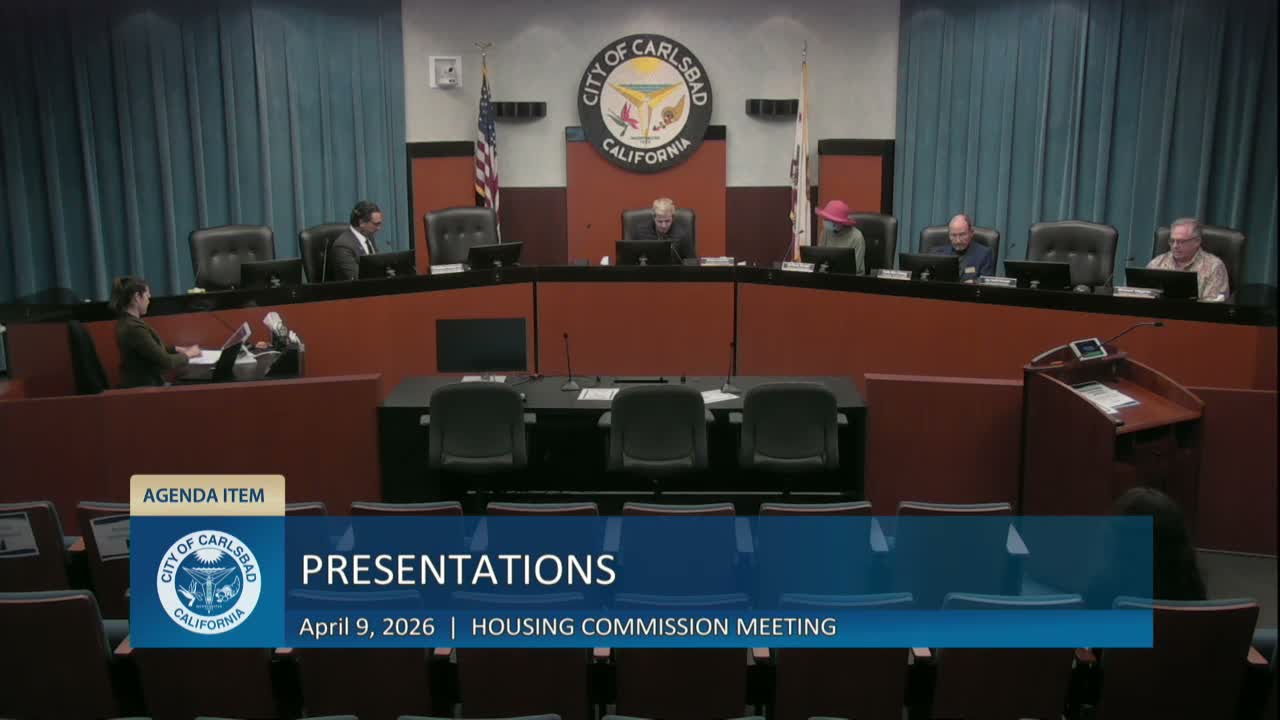
Amalia Romero, Fair Housing Managing Attorney at the Legal Aid Society of San Diego, told the Carlsbad Housing Commission on April 9, 2026, that disability‑accommodation refusals, tenant‑screening practices and assistance‑animal restrictions are among the most frequent fair‑housing problems her office sees.
Romero, who led a presentation funded through community development block grant partnerships, summarized federal and California protections — including the federal Fair Housing Act, Section 504 of the Rehabilitation Act and federal Violence Against Women Act (VAWA) protections — and noted state additions under California law. "Fair housing laws apply to dwellings," Romero said, and they protect people from discrimination based on race, color, national origin, religion, familial status, disability and other categories added under state law.
Her office emphasized two legal theories commonly used in claims: disparate treatment (intentional discrimination) and disparate impact (neutral policies that disproportionately harm a protected class). Romero said disparate‑impact claims can arise when neutral admission or screening policies have unequal effects across groups. "Sometimes there's no explicit statement, and you have to look at outcomes across applicants," she said.
Romero highlighted recurring local issues: increased use of credit and criminal background checks in tenant screening; difficulty obtaining approval for assistance animals when vendors require registration fees or third‑party verification; and refusal to provide reasonable accommodations for people with disabilities. "We see refusal to accommodate disability as our number one issue," she said. She described cases where medications, mental‑health treatment, or a VA letter explained past screening flags and where an accommodation or alternative evidence could address a landlord's concerns.
On assistance animals, Romero said pet rules such as deposits, breed or weight restrictions, and mandatory pet addenda are sometimes applied improperly to assistance animals. She warned that third‑party screening firms can create additional barriers by flagging legitimate documentation. "We're seeing screening technology sometimes flag a clear VA letter, which then delays or denies approval," she said.
Romero outlined enforcement and remedy pathways: informal resolution and mediation, administrative complaints to HUD or state civil‑rights departments, and litigation in federal or state court. She urged residents to "document, document, document," noting that written records help evaluate claims and streamline advocacy.
Commissioners asked practical questions about AB 2493 and whether application or holding fees should be charged when a unit is not available; Romero said the statute is complex and depends on the housing provider's policies, but generally fees should be returned if no applicant is chosen. She also confirmed that VAWA protections apply to survivors regardless of gender and to several covered acts including stalking.
Romero described Legal Aid’s local capacity: a fair‑housing team of several attorneys and advocates supplemented by testers and volunteers, with countywide caseloads the office closes roughly 500–600 cases per year. Funding sources include HUD, city grants and private foundations.
The presentation concluded with Romero offering Legal Aid’s intake and referral services to Carlsbad residents. Staff closed the agenda item after commissioners declined further public comment.
The commission received the presentation and had staff note the availability of Legal Aid resources for residents.