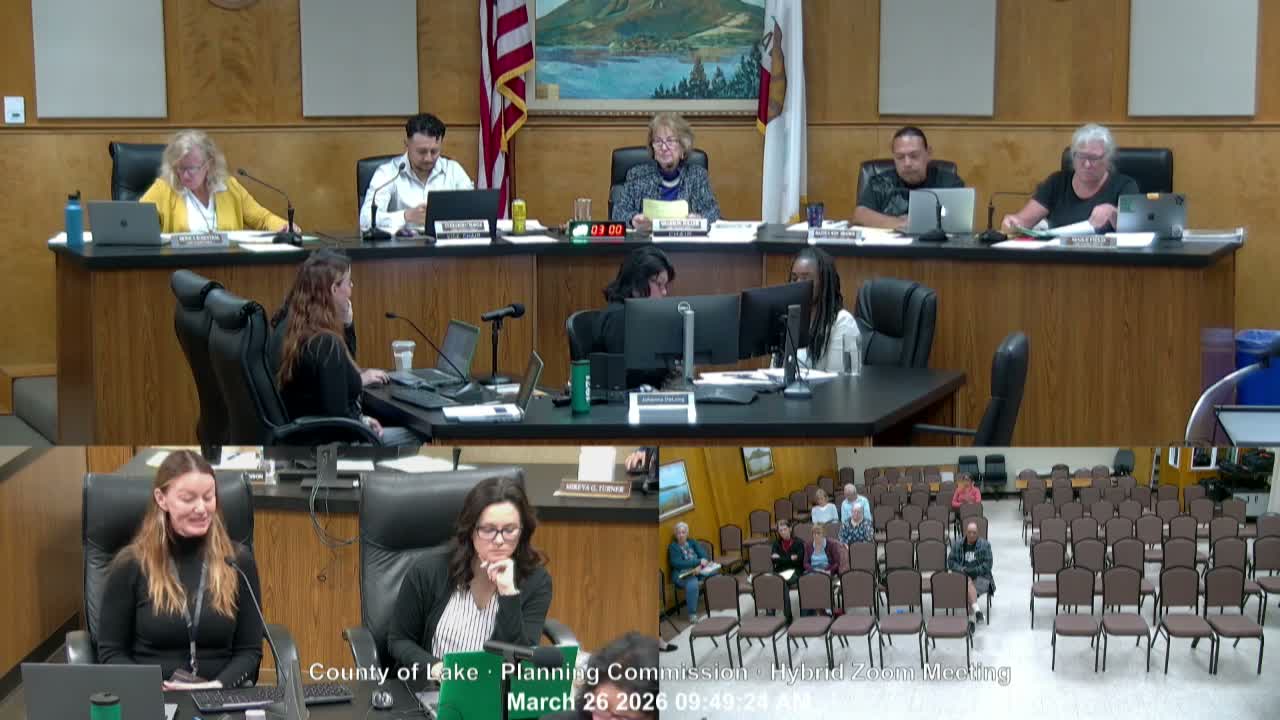
Commission denies Soda Bay Road greenhouse cannabis project amid biological and cultural resource concerns
Loading...
Summary
After extensive public comment and technical exchanges about flooding, wetland and cultural resources, the Lake County Planning Commission voted 4–1 to deny the design review and major use permit PL25‑67 for a mixed‑light cannabis campus on Soda Bay Road.
The Lake County Planning Commission voted March 26 to deny a major use permit and design review for a proposed mixed‑light and greenhouse cannabis campus on Soda Bay Road (PL25‑67), citing unresolved biological, hydrological and cultural‑resource concerns raised during public comment and by commissioners.
Associate planner Trish Turner presented the project as a multi‑acre cultivation campus with up to 43,200 square feet of mixed‑light canopy (33,000 square feet inside greenhouses), a 6,000‑square‑foot processing and nonvolatile manufacturing building, and a 2,400‑square‑foot distribution center on a combined parcel of approximately 44.31 acres in the Lakeport planning area. Turner said the parcel lies in a FEMA AO flood zone and noted mitigation measures written into the draft mitigated negative declaration to protect the Clear Lake hitch, including setbacks and restrictions on ground‑disturbing work where feasible.
Public commenters and local organizations pressed the commission for more recent biological surveys and a more thorough cumulative impacts review. Mary Jo Velasquez of the Lake County Land Trust said flooding from the site drains into an adjacent preserve and can strand Clear Lake hitch, and urged caution given ongoing efforts and expenditures to reduce phosphorus in Clear Lake. Donna Makowitz and other commenters noted that the primary biological field survey relied on data collected in 2019, a drought year, and argued that recent observations of high wildlife use and spawning habitat undercut the staff conclusion that impacts would be less‑than‑significant with mitigation.
Cultural resources emerged as a central concern. A commissioner referenced the initial study’s cultural‑resources section showing dozens of isolated artifacts and at least one area that could qualify as a significant historic site, and asked whether monitoring, data recovery and tribal consultation would be sufficient to address potential impacts. Project consultant Trey Sherrill and staff said the most sensitive finds were on an adjacent parcel and that the proposed cultivation footprint did not contain the dense artifact area, but they acknowledged a high likelihood of additional discoveries and described proposed tribal monitoring, pre‑construction surveys and conditions requiring a tribal monitor and mitigation measures if finds occur.
Flooding and hydrology also featured heavily in the record. The applicant’s hydrology report estimated peak proposed water use at about 9,426 gallons per day and identified two on‑site wells; public commenters and at least one commissioner questioned that figure and asked for actual meter records, pointing to observed site flooding and recent videos submitted by neighbors. County building staff and the project consultant described how greenhouses would be built to flood certification standards, elevate equipment and provide flood vents so structures can withstand moving water.
Several commissioners said the record and the materials before them were insufficient to make a finding of less‑than‑significant impact. Commissioner (speaker 6) moved that the commission find PL25‑67 cannot be mitigated to less‑than‑significant and that the project did not meet required findings under the county zoning ordinance; the motion was seconded by Commissioner (speaker 12). The commission voted to deny the design review and major use permit (motion passed 4–1). Staff reminded applicants and the public of the seven‑day appeal period to the Board of Supervisors.
The denial cited multiple concerns: reliance on a 2019 biological field survey conducted during drought conditions, unresolved questions about current hydrology and cumulative water use, and cultural‑resource sensitivity that may require data recovery and additional mitigation beyond what was in the initial study. Staff and the applicant agreed that some mitigation measures—tribal monitoring, pre‑construction surveys and construction timing restrictions—would be required before ground disturbance, but commissioners concluded the information before them was insufficient to support approval at this time.
The project record includes the hydrology and drought management plans (attachment 5), the initial study (recirculated after identified errors), and staff recommendations that would have required conditions to protect the Clear Lake hitch and limit potential runoff into Manning Creek. The commission’s denial leaves open the option for the applicant to revise the project, provide updated biological surveys, clarify hydrology and water‑use monitoring, and seek resubmittal or appeal.