Get Full Government Meeting Transcripts, Videos, & Alerts Forever!
Get email alerts on the Cannabis Permitting topic
No spam. Unsubscribe anytime.
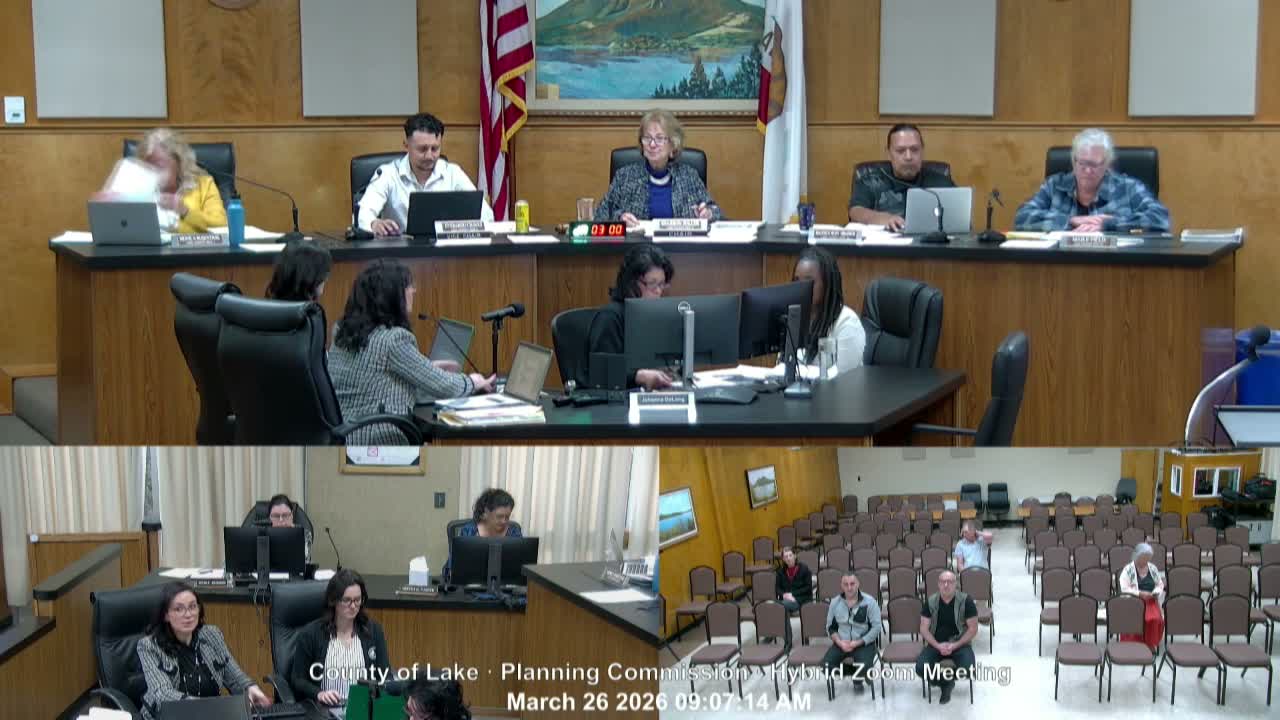
Planning commission approves Greenfield Farms outdoor cannabis permit with mitigation conditions
Summary
The Lake County Planning Commission voted to approve PL25-306, allowing roughly 86,308 square feet of outdoor commercial cannabis canopy at 20150 Black Bass Pass Road after staff said environmental impacts could be mitigated and the applicant confirmed water metering and setbacks.
The Lake County Planning Commission on March 26 approved a major use permit and adopted a mitigated negative declaration allowing Greenfield Farms (PL25-306) to operate about 86,308 square feet of outdoor commercial cannabis canopy at 20150 Black Bass Pass Road in Lower Lake.
Senior planner Mary Claybon told commissioners the roughly 40.56‑acre site includes two cultivation gardens totaling 86,308 square feet, a proposed 1,440‑square‑foot processing building with ADA restrooms, and required fire‑suppression water storage. Claybon said the project was analyzed under the Lake County General Plan, local area plans, county zoning code and CEQA, and that staff’s draft mitigated negative declaration (attachment 4 in the staff report) concluded identified impacts could be mitigated to less‑than‑significant with the conditions listed in staff’s recommended approval.
Commissioners questioned operational details during a lengthy Q&A. A commissioner asked why temporary shipping containers were allowed for up to three years; Claybon cited county ordinance provisions that permit temporary processing in shipping containers for up to three years provided container square footage does not exceed 10% of the permitted canopy. Commissioners also asked about flexibility in hours during harvest; Claybon said harvesting for commercial cannabis is typically conducted in evening hours and the permit would allow additional hours for harvest periods under the county’s code language. The staff memo noted that the project previously operated under an early activation in 2020 and that the proposed permit would use the same footprint.
Water use and cumulative impacts drew public attention. The applicant’s project manager, Alexander Yusupov, told the commission a water meter was installed in 2021. Commissioners and members of the public pressed staff for cumulative water‑use data; Claybon said a recent agency comment requested a cumulative‑impacts map and staff could provide counts of approved projects within 1‑ and 3‑mile radii. Staff later confirmed four approved projects within one mile and nine within three miles of the site.
A technical exchange between a commissioner and the project’s hydrology consultant highlighted differences in assumptions used to estimate irrigation demand. One commissioner calculated that, at five‑foot plant spacing and 6 gallons per plant per day, the site could require tens of thousands of gallons per day; consultant Kyle Geithner and the applicant’s team said layout and canopy spacing assumptions differ from that simplified estimate and noted the hydrology report used conservative, state‑provided per‑plant numbers. Claybon offered to provide meter records and additional hydrology detail to the commission if requested.
Following discussion, a commissioner moved to adopt the mitigated negative declaration and approve PL25‑306 with the conditions and findings in the staff report dated March 26, 2026; the motion was seconded and carried. The commission and staff reminded attendees that the zoning ordinance allows a seven‑calendar‑day appeal period to the Board of Supervisors.
The permit approval includes the conditions and mitigation measures listed in the staff report and the draft mitigated negative declaration. Staff said the record includes biological and botanical studies provided by the applicant (2019 wetland delineation, a 2021 botanical study and a Groening & Associates biological study dated August 2025) and that the project footprint would remain within previously authorized early‑activation areas. The applicant and staff said they will coordinate with the tribe should any inadvertent cultural discoveries occur during ground‑disturbing work.