Get Full Government Meeting Transcripts, Videos, & Alerts Forever!
Get email alerts on the Student Device Policy topic
No spam. Unsubscribe anytime.
Torrance Unified presents AB 3216-aligned cell-phone policy draft after 4,000-stakeholder survey; board to revisit in February
Summary
District staff presented a first reading of a revised mobile-device policy aligned with Assembly Bill 3216 after more than 4,000 survey responses and student visits to feeder middle schools. The draft would prohibit devices for elementary/middle students during school hours and limit high-school use to teacher-authorized instructional purposes; trustees pressed staff on enforcement, exceptions and mental-health benchmarks.
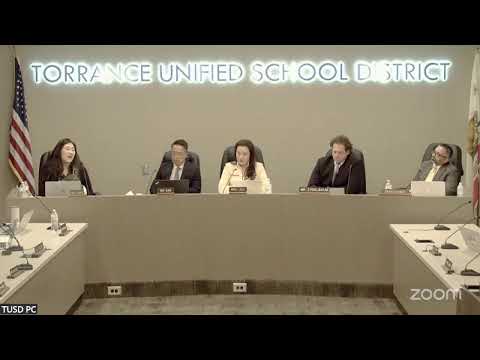
Torrance Unified staff presented a first reading of a revised student mobile-device policy Jan. 20, saying the update is intended to align district rules with Assembly Bill 3216 and California School Boards Association guidance and to reflect broad community input.
The draft, presented by district staff and student board members, would ban use of mobile communication devices for elementary and middle school students during the school day while under district supervision (devices off and kept put away; students would use office phones for necessary contact). High school students would be restricted from using devices during instructional periods unless a teacher or administrator authorizes their use for educational purposes; earbuds would be allowed only when required by assignment. Staff said the revision also clarifies that cyberbullying is prohibited and broadens the types of devices covered.
"This proposed update is based on Assembly Bill 3216," a staff presenter said, describing three stakeholder committee meetings, community forums and a district survey that drew over 4,000 respondents — the highest response rate for a recent TUSD-issued survey. Student board members who visited feeder middle schools told the board that most middle-school students support keeping phones away during instruction, citing distraction and cheating as primary concerns, while opinions varied about breaks and passing periods.
Trustees focused questions on enforcement and exceptions. "What are the consequences for using the cell phone outside of district policies?" Trustee Hahn asked. Staff said consequences will be defined at the school level in an updated discipline matrix tied to the board policy and that administrators will validate exceptions such as medical needs, students whose IEPs require device access, or translation for English learners.
Trustee Park and others pressed staff on the policy’s language for high-school students, asking whether describing use outside class as "discouraged" is sufficiently clear. Staff defended a graduated approach, noting high schools rely on apps such as Remind or Band for communications and some assignments arrive via phones. "We saw a lot of kids talking to each other and doing more social things," a district presenter said of high-school campuses, arguing a stricter campuswide ban would be hard to enforce immediately.
Trustees also sought benchmarks for cyberbullying and mental-health impacts tied to device use; staff proposed monitoring counseling and discipline records and said counselors and teachers would continue to support students affected by online interactions.
Student board members offered compromise language used in the draft — e.g., prohibiting devices during instructional time while allowing supervised and instructional uses — and suggested that permitting limited use during passing periods might reduce covert rule-breaking (students using devices in bathrooms). The board thanked students and staff for the outreach and agreed to return the policy for additional discussion and possible adoption at the Feb. meeting.
The board did not take final action on BP 5131.8 during the Jan. 20 meeting; staff said the item will return for a second reading and possible approval on Feb. 17. The district encouraged additional public input ahead of that session.