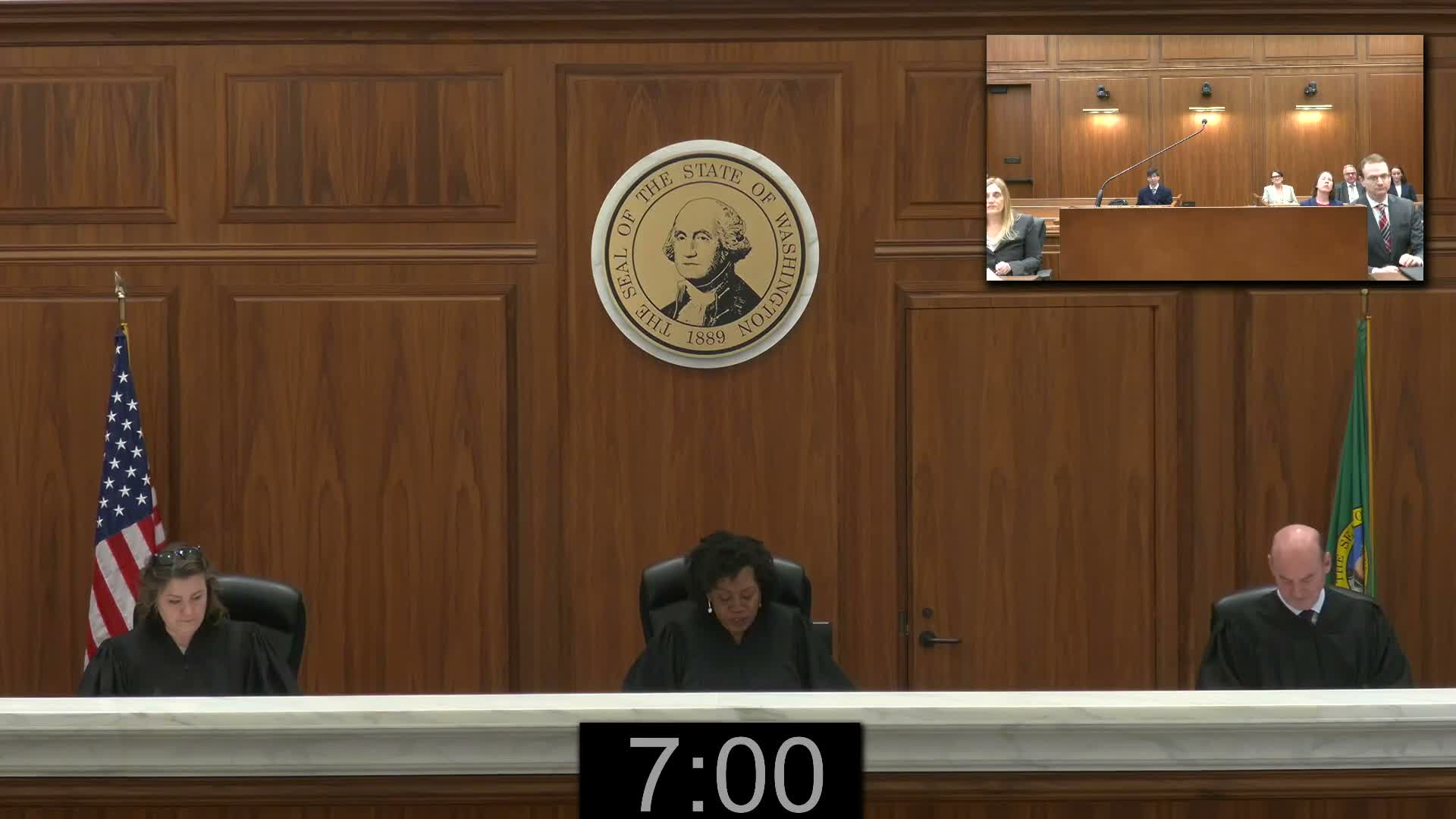
Appellate panel weighs when parents 'substantially improve' in In re IDW termination appeal
Loading...
Summary
At oral argument, the mother’s appellate counsel said the rebuttable presumption of 'little likelihood' did not arise or was rebutted after treatment and periods of sobriety; the respondent argued the juvenile court properly weighed the parent's long history of relapse and the child's need for speedy permanency. The matter was submitted for decision.
An appellate panel heard argument in In re the parental rights of IDW on whether the juvenile court misapplied a statutory rebuttable presumption that a parent has a “little likelihood” of remedying deficiencies that led to dependency.
Christopher Petroni, appellate counsel with the Washington Appellate Project for the child’s mother, told the court that "the presumption did not arise in this case" and that the mother had produced evidence of engagement and improvement. Petroni pointed to immediate treatment enrollment, participation in Family Treatment Court, withdrawal management and intensive outpatient treatment, and noted the mother achieved thirty days of sobriety and later a three‑month period of sobriety during the relevant year. "She relapsed after that fact, during that 12 months," Petroni said, but argued relapse is a symptom of recovery and should not be treated as resetting progress to zero.
Petroni urged the panel to clarify what "substantially improve" means for purposes of the presumption, saying the statutory text is ambiguous and legislative history shows the presumption was intended to identify parents "clearly incapable of correcting those conditions." He argued that, because the parent's burden when confronting a rebuttable presumption is a burden of production, the mother supplied evidence of engagement and improvement sufficient to shift the burden back to the department.
Judges on the panel pressed both sides for concrete record examples of what would meet the standard. One judge asked what additional steps—such as completion of parenting classes or specialized coaching for IDW's needs—would be necessary beyond a period of sobriety to rebut the presumption. The panel also queried how evidence from later years (2023–24) should be weighed against the statute’s 12‑month framing tied to the post‑disposition period (here March 2021 to March 2022).
On behalf of the respondent, an agency attorney defended the juvenile court’s approach, stressing the court’s duty to prioritize a child’s speedy permanency. The respondent argued that after "copious services" and repeated treatment attempts the record showed persistent "peaks and valleys" in the mother's compliance and that the court had ample evidence—ranging from missed visits to an incident involving a vape cartridge and concerns about supervision—to support its finding that the parent's deficiencies were unlikely to be remedied in the child’s near future. The respondent said the trial court’s findings were supported by "clear, cogent, and convincing evidence" of the elements necessary for termination.
The panel discussed precedent (referred to in argument as GES) on rebuttable presumptions and the difference between a burden of production and a burden of persuasion. Counsel and judges also debated whether an erroneous application of the presumption would be harmless error here — that is, whether there was a reasonable probability the trial court would have reached the same result absent any misapplication.
Both sides acknowledged the tension between adult recovery timelines for substance use disorder and the statutory goal of timely permanency for children. Petroni urged that showing sustained, substantive improvement should be sufficient to rebut the presumption, while the respondent maintained that the juvenile court appropriately considered the totality of the mother's treatment history and the child's current needs.
The panel took no decision at argument; the presiding judge said, "This matter is submitted," and moved on to the next case.