Get Full Government Meeting Transcripts, Videos, & Alerts Forever!
Get email alerts on the Infrastructure Utility Undergrounding topic
No spam. Unsubscribe anytime.
Council sets hearing for five underground utility districts after questions about cost and timing
Summary
The City Council voted 8–1 to set Feb. 25, 2025 as the public hearing date to consider creation of five underground utility districts and adoption of related CEQA documentation. Staff said the work is funded by an existing utility surcharge and projects typically take several years for design and construction.
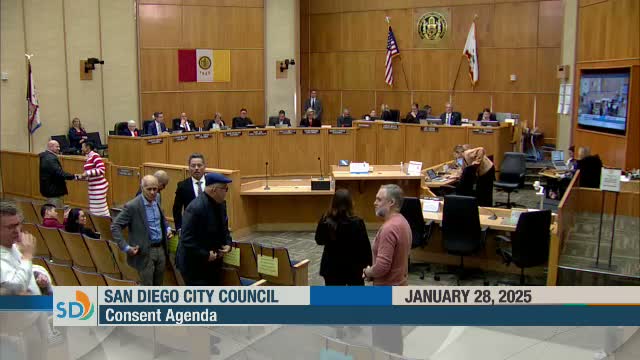
The San Diego City Council on Jan. 28 voted to set a public hearing on Feb. 25 to consider creating five underground utility districts in neighborhoods including North Claremont, Barrio Logan, Kensington and others, and to adopt a final mitigated negative declaration for the projects.
Chelsea Clacious, deputy director in the Transportation Department, and Jim Debong of the Utility Undergrounding Program described the four‑step process staff will follow: (1) council action to set a noticed public hearing, (2) mailed notice to property owners and utilities, (3) a public hearing and CEQA review, and (4) final approval and assignment of responsibilities for undergrounding. Clacious said the city aims to set the hearing four weeks after the meeting and that full design and construction often span multiple years.
Staff responded to repeated public concerns about homeowner costs and timing. “Yes, your understanding is correct,” staff told council when asked whether property owners would be charged directly. “This is funded by a surcharge which is a percentage of the utility bill that goes into the surcharge fund and that is what pays for all underground throughout the entire city. There are no new fees or cost requirements on any subject residents.”
Neighbors who spoke at the meeting expressed both support for undergrounding as a wildfire‑risk reduction and frustration over communication and maps. Doreen Diaz said she supported the projects but criticized repeated misnaming of neighborhood boundaries on maps and urged clearer public notice. Several commenters asked why earlier 2019 notices (Block 6K2) had not progressed to construction.
Councilmembers also pressed staff about schedule and communications: staff said projects are complex community improvements that can take five to seven years from approval to completion, with design phases of up to 12–18 months and construction phases that may last one to four years. Staff said they are improving communications and will hold community forums during design and before construction.
Councilmember Hilo (Elo) Rivera moved to set the public hearing; Councilmember Marty Von Wilpert seconded. The motion passed 8–1, with Council President La Cava voting no. The vote sends the items forward to the noticed public hearing process, where property‑owner notices and CEQA materials will be circulated and additional public input collected.
Next steps: staff will mail notices to affected owners and utilities, hold community meetings during design, and return for the noticed public hearing on Feb. 25. If the hearing finds the district formation is in the public interest, staff will proceed with detailed design and later construction scheduling.