Board debates Lightfoot small-area plan and CIP adjustments as staff reallocates Yorktown project funds
Loading...
Summary
At an April 9 work session the York County Board moved design funding into earlier CIP years for a Yorktown campus project, accelerated a fire station study and debated a proposed $400,000 Lightfoot small-area plan; supervisors questioned spending on privately owned land and asked staff to explore a reduced in‑house option before committing.
York County staff presented revisions to the county’s Capital Improvements Plan at a Board of Supervisors work session on April 9, 2026, including accelerated design funding for a Yorktown campus project and schedule shifts for fire station and library projects. Supervisors also debated whether to fund a proposed Lightfoot small‑area planning effort and how much to budget for consultant work.
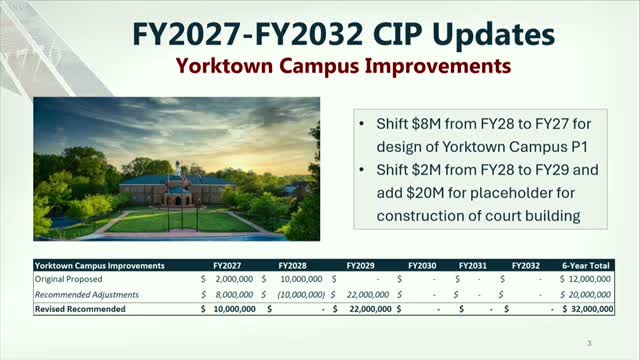
Susan (county staff) said the space‑study implementation project was renamed "Yorktown Campus Improvements" and described placeholder dollars moved in the CIP. "We originally had $12 million in here for this project," Susan said; she said staff had "accelerated some of that funding to '27'" and moved construction dollars to FY29 while adding $20 million as a placeholder for later phases. She emphasized the numbers are preliminary and will be refined during design and in the 15‑year CIP update.
Staff also reported accelerating a fire station renovation study from FY30 to FY28 to look holistically at station locations and moving initial library design for the north county to FY28 to align with contract timing. The board asked staff to provide a financing plan and to consider policy options in conjunction with debt projections.
A lengthy discussion followed about a proposed Lightfoot small‑area plan for the former pottery/warehouse property near Route 199. Staff described the small‑area plan as a focused comprehensive‑plan exercise with outreach and transportation analysis. Board members repeatedly raised two objections: the property is privately owned and the county cannot itself build the state road infrastructure that developers or VDOT would need; and the $400,000 consultant estimate is large for a property the county does not own.
One supervisor urged a smaller immediate commitment: "Maybe you put $100,000 forward this year and see what you can do internally," while another suggested $200,000 would be acceptable as a placeholder. Others argued the county staff, which has experienced recent turnover, lacks capacity to do the full work in house and that a consultant would be costly but may be required to deliver a robust public engagement and plan.
No formal appropriation was recorded during the session. Board members agreed to move some CIP line items and to return with firmer cost information. Staff said they would produce a memo on how the CIP adjustments interact with single‑year assessment timing, debt policy and next year’s budget process.
The session closed with supervisors cautioning that next year’s tax‑rate discussion will be sensitive and that any move to a single flat tax rate will need phasing or careful voter and budget consideration.