San Diego council votes to repeal contested ‘Footnote 7,’ restoring larger lot minimums after intense public outcry
Loading...
Summary
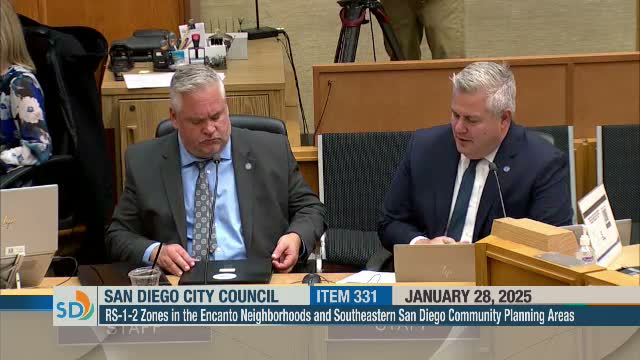
After hours of public testimony from hundreds of residents, the San Diego City Council voted unanimously Jan. 28 to remove “Footnote 7” from the city’s Land Development Code, restoring a 20,000‑square‑foot minimum lot size in the affected RS1.2 areas and directing staff to return with related ADU‑program review.
San Diego’s City Council voted Jan. 28 to remove a controversial zoning exception known as Footnote 7 from Table 131.04D of the Municipal Code, a move that restores a 20,000‑square‑foot minimum lot size in parts of the Encanto/Choice Valley area and southeastern San Diego.
The decision follows a Planning Department presentation and more than an hour of public remarks from residents, community planners and advocates who said the footnote was quietly inserted into the code in 2019 and used to approve higher‑density projects without adequate community notice or environmental review. “Footnote 7 must be repealed retroactively because it was unlawful at inception and is poised to do irreversible and severe harm to our community,” said Andrea Hetero, chair of the Choice Valley Community Planning Group.
City Planning Program Manager Seth Lichney told the council that Footnote 7 had been applied only to limited neighborhoods and that its adoption did not follow best planning practices. Staff recommended repeal to align zoning rules citywide with the 2015 Encanto Community Plan and noted that removing the footnote would restore the development potential assumed in that community plan. Lichney said the city’s housing‑element adequate sites inventory would not be reduced below state requirements by the change.
Scores of residents urged the council not only to repeal the footnote but also to bar projects that have relied on it from moving forward without new approvals. Several speakers raised CEQA concerns and accused the prior process of lacking transparency. Supporters of the repeal emphasized equity, arguing the change had disproportionately targeted a historically under‑resourced, largely non‑white area. “This policy’s disparate impact, combined with its procedural irregularities, renders it indefensible,” said a community speaker.
Councilmember Vivian Moreno moved the proclamations earlier in the meeting; later, Councilmember Monica Montgomery Foster (first reference: Councilmember Monica Montgomery Foster) introduced the motion to repeal Footnote 7, seconded by Councilmember Raul Campillo. After extended debate — during which the city attorney advised that changes to the city’s ADU density bonus program would require a separately noticed hearing — the motion to adopt the Planning Department recommendation passed unanimously, 8–0 (one councilmember absent).
The council’s action does not automatically retroactively void approvals that have already completed required ministerial steps; several community leaders and advocacy groups urged the council to return with language that would explicitly halt projects that have relied on the footnote. Councilmembers asked staff to return in short order with a review of the city’s ADU density bonus program and with clear guidance on how pending projects relying on Footnote 7 would be handled.
What happens next: the repeal ordinance takes effect per city procedures (the ordinance becomes effective 30 days after the mayor’s signature), and affected projects will continue to be processed under the law in effect at the time their applications were deemed complete unless the council or a court orders otherwise. The council requested that staff come back with a separate, noticed review of ADU rules and other related programs; the city attorney cautioned that any action on those subjects must be noticed separately under Brown Act and state requirements.