York County Board of Supervisors hears two courthouse expansion options, asks for cost estimates
Loading...
Summary
Architects from PMA Architecture and engineers from Timmons Group presented two conceptual courthouse designs for Yorktown: a three-story option that keeps more existing campus fabric and a two-story option that reduces visual impact but requires closing Alexander Hamilton Boulevard. The board asked staff for cost deltas and more design work before choosing a path.
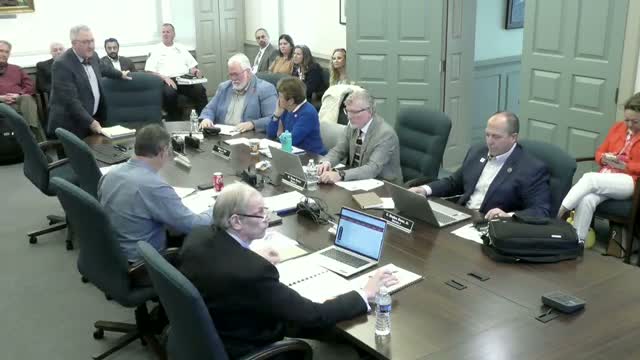
Architects and court planners presented two conceptual designs for a proposed York County courthouse expansion at a Board of Supervisors work session on April 9, 2026, and the board asked staff to return with cost comparisons before selecting a direction.
PMA Architecture and partners described a three‑story courthouse option sited to the east of the existing courthouse that would allow the current courthouse to be converted to county administration and avoid early investment in structured parking. Akshar Patel of PMA said the three‑story option "meets the long term court needs without any complex renovations to the existing building" and would allow departments to relocate into the existing courthouse after court functions move into the new building.
The team’s second schematic places a two‑story courthouse to the west, centered on Alexander Hamilton Boulevard, with a roundabout and more distributed public and employee parking. Thad Rich of the Timmons Group said his traffic engineers found that closing the Alexander Hamilton exit from U.S. 17 "does not affect fire and EMS response, police response" and would improve parking distribution and reduce the building’s visual prominence in the historic Yorktown area. Several supervisors expressed concern about closing the roadway and the added site reconstruction that would be required.
Keith Fentress, the courts planner, walked the board through operational requirements: a basement sally port and detainee holding, stacked courtrooms, separate elevators and circulation for judges, detainees and the public, jury assembly and clerk spaces. He said juvenile and domestic relations courtrooms should be physically separated from other court functions to reflect the sensitive nature of those proceedings; the presentation cited a 20‑year planning horizon and projected parking needs that the team summarized during the discussion.
Board members and staff focused discussion on trade‑offs: the three‑story option is simpler to phase and likely cheaper initially, while the two‑story alternative lowers visual impact and distributes parking but is more complex and may require closing Alexander Hamilton Boulevard. The PMA team recommended advancing to a design phase to resolve geotechnical, stormwater and access uncertainties; the presenters said design work is the most practical way to reduce cost uncertainty.
Supervisors asked for a September update with a rough estimate of the cost delta between the two options before picking one. One board member warned against very large figures, saying, "I'm not going to go for a $200 million dollar operation," and several members emphasized that price differences could determine the final choice. The board signaled consensus to proceed far enough in design to quantify costs and the delta between options, with staff to return with more detailed estimates and visuals.