Get Full Government Meeting Transcripts, Videos, & Alerts Forever!
Get email alerts on the Affordable Housing Preservation topic
No spam. Unsubscribe anytime.
City Council adopts ordinance to give qualified buyers earlier notice and purchase rights for deed‑restricted housing
Summary
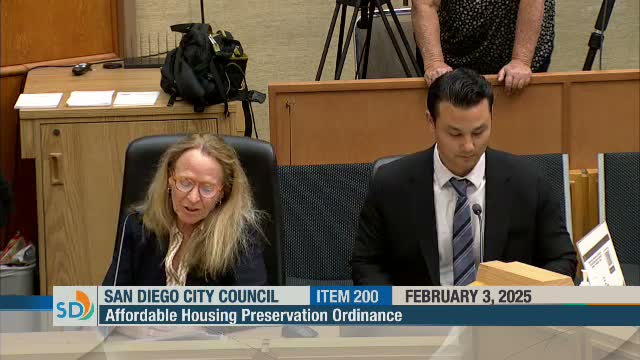
The council unanimously adopted an Affordable Housing Preservation Ordinance requiring owners of assisted, deed‑restricted properties to provide a notice of intent to sell, a right of first offer and a right of first refusal to qualified entities and expanded local notice beyond state timelines.
The San Diego City Council unanimously approved an ordinance Tuesday that requires owners of assisted, deed‑restricted multifamily housing to issue a notice of intent to sell and to provide qualified entities a right of first offer and a right of first refusal when properties are offered for sale.
Councilmember Moreno, who introduced the item, told the council the city needs stronger tools to keep homes affordable and prevent displacement. “When a building with deed restrictions goes on the market, qualified entities will be notified and have an opportunity to buy it before it’s marketed more broadly,” Moreno said.
Housing Commission staff and legal advisers described how the ordinance supplements state preservation law. Wendy DeWitt, Vice President of Preservation at the San Diego Housing Commission, said the proposal expands opportunities by requiring notice whenever an owner intends to sell, regardless of when affordability restrictions end. The ordinance sets a three‑month pre‑listing notice of intent to sell that gives qualified entities 30 days to express interest and 60 days to submit an offer; owners must accept qualified offers or follow the ordinance’s counteroffer procedures.
Speakers at Tuesday’s hearing included tenant advocates, Legal Aid representatives and housing‑sector groups. Jesse Ramirez of City Heights CDC urged passage as “a proactive anti‑displacement measure.” Dante Golden of the San Diego Housing Federation asked the council to pair the ordinance with a dedicated acquisition fund so qualified entities have the capital to act when notices arrive.
The ordinance applies to assisted housing developments of five or more units that receive federal, state, or local government assistance or are deed‑restricted under local land‑use programs. It requires owners to post a notice on site and to file the notice with the Housing Commission, which will publish it on its website. If no qualified entity submits an offer, the owner may market the property generally.
Exemptions include transfers by gift or operation of law, foreclosure, certain refinancings that do not change ownership, and developments where 30% or fewer units are affordable under local programs (a change from an earlier draft that used a 25% threshold and was revised to align with recent state preservation changes). The ordinance also includes enforcement options such as injunctive relief and potential civil penalties under existing municipal code provisions.
Councilmembers praised the lengthy outreach to stakeholders; Moreno noted the Land Use and Housing Committee and Housing Commission had vetted the proposal. Moreno and other councilmembers emphasized the ordinance is one tool in a suite of preservation, production and protection policies and reiterated a need for funding to act on preservation opportunities.
The council adopted the ordinance 9–0. The ordinance amends San Diego Municipal Code Chapter 9, Article 8. The Housing Commission and City Attorney worked together on revisions to timeline and exemption language before the adoption.
Next steps: the ordinance’s implementing procedures will be handled by the Housing Commission, which will publish notices on its website and begin accepting letters of interest once owners file notice of intent to sell.