Lifetime Citizen Portal Access — AI Briefings, Alerts & Unlimited Follows
Cave Creek unveils preliminary $85 million FY2027 budget; residents press for more notice on town hall plan
Loading...
Summary
Finance director Sherry White presented a preliminary FY2027 budget with about $85 million in resources and roughly $44 million in CIP spending; residents questioned notice and public engagement on a proposed town hall remodel and a $16 million placeholder for land acquisition.
Sherry White, Cave Creek’s finance director, presented the town’s preliminary fiscal year 2027 budget to members of the public, saying the town expects roughly $85,000,000 in resources available and is proposing estimated expenditures of about $79.6 million for the base budget, plus supplemental requests that lift the proposed total to about $80.4 million.
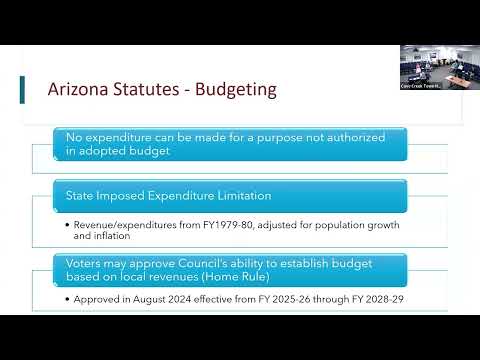
Why it matters: the budget sets the town’s spending cap under Arizona’s expenditure-limit rules and frames priorities for capital projects, utilities and public safety over the next 12 months. White told attendees the adopted budget becomes the town’s expenditure cap under the home-rule authorization voters approved in August 2024.
The FY2027 proposal groups spending into a base operating budget, supplemental requests and a capital improvement plan (CIP). White said the packet shows roughly $44 million in CIP projects, with the largest single program in the Cave Creek water fund (about $18 million, including $12 million for water resources). The CIP also includes a $16 million placeholder for a potential 4,000-acre land acquisition and roughly $6.2–6.3 million shown for a town-hall remodel in the packet.
On revenue mix and assumptions White said the town expects a mix of financing sources, including tax collections, utility charges and assumed debt financing. The presentation listed transaction privilege taxes (TPT) at about 24% of certain revenue assumptions, state shared revenue at 4%, and utility charges at roughly 19%. White noted lower-than-projected tourism receipts and reduced water usage linked to weather and customer conservation (AMI meter leak detection), which reduce some revenue lines.
Supplemental requests included ongoing items — $35,000 for additional information-technology support, proposed community-grants funding increased from $40,000 to $60,000 (+$20,000), and an estimated $60,000 for additional seasonal law-enforcement coverage during peak months. One-time requests included $50,000 for broadcast equipment upgrades, about $96,000 for CIP consulting, and roughly $500,000 proposed to help catch up on streets work. Departments requested more than $1.2 million in one-time items, White said; the proposed budget includes about $726,000 of one-time costs and does not include two requested positions that would total about 1.5 FTEs (~$164,000).
During the public-comment period, resident David Phelps criticized town staff and council for what he described as inadequate public notice and opportunity for early input on the town-hall renovation and expansion. "You got a $6,200,000 Taj Mahal gift," Phelps said, arguing the public had not been informed early enough and asked where such projects had been publicly posted in prior years. Phelps cited language in the CIP about soliciting town-citizen input and said he could not find prior notice online.
Town staff and council members disputed that claim. Paul Larson, the town’s director of communications, said the project and meeting information were published in the town’s Prospector newsletter, on social media and on the town website, and offered to send Mr. Phelps the relevant postings. A council member said the town-hall need and a $5 million–$7 million planning range had appeared in earlier budget/CIP discussions and budget hearings.
White also described Arizona’s statutory framework and the town’s choice to operate under home rule to set its expenditure cap for FY26–FY29. She listed alternative approaches that require voter approval, including a permanent base adjustment, capital projects accumulation fund, or a one-time override.
Next steps: White said council work sessions are scheduled next week (three days starting at 3 p.m.) to review the proposed budget; a tentative adoption is set for May 19 and final adoption for June 16, under the town’s adopted process for setting expenditure limits.
The town said the consolidated budget book would be posted on the website and staff offered to provide copies to residents who could not find earlier notices.