Feasibility study recommends independent arts council and a public art commission; council told consultant work will follow
Loading...
Summary
A feasibility study presented to Charlottesville council recommends establishing a public art commission for collection stewardship and an independent regional arts council to coordinate funding and programs; presenters urged modest startup staffing and proposed funding options including a percent-for-art and strategic matches.
Community leaders and city staff presented a feasibility study on April 8 recommending two complementary steps to strengthen arts coordination: stand up a public art commission to manage the city’s public art collection and create a separately governed local or regional arts council to coordinate funding, communications and services across the local arts ecosystem.
Maureen Dondek, executive director of New City Arts, summarized the study’s findings: Charlottesville has substantial arts activity but lacks coordinated infrastructure. The steering process — she said — engaged 464 participants, 49 local organizations and produced recommendations for governance, staffing and phased funding. The study team recommended beginning with a small operational core (roughly two to three full‑time positions) to lead coordination, communications and administration while pairing that capacity with a public art commission housed in city processes to handle review, maintenance and acquisition policies.
Ruby Lopez Harper, who led the comparative analysis, told council the study benchmarked peer cities and found multiple viable governance models (municipal, nonprofit and hybrid) but a consistent function: coordination, transparency and long‑term stewardship. Harper said a coordinated model improves equity and access by making information and opportunities more consistent across the ecosystem.
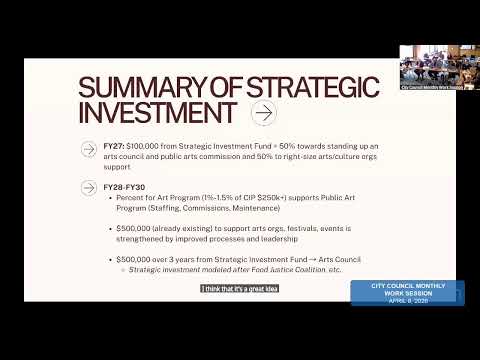
Recommendations discussed included a percent‑for‑art set‑aside on larger CIP projects to fund public art and maintenance; a modest initial strategic investment from existing one‑time funds to engage consultants and staff for the transition; and measures to make existing grants (for example, from the Vibrant Community Fund) more strategic rather than ad hoc. Presenters suggested a phased funding path, including an initial consultant allocation to build procedures for a public art commission and a multi‑year plan to establish the arts council as a 501(c)(3) that could leverage philanthropic matching.
Council members raised concerns about sustainability and recurring costs, the limits of one‑time funds, potential effects on other budget priorities and the timeline for establishing a separate nonprofit. Staff said a public art commission ordinance and a supporting funding resolution were anticipated on or near the April 22 council docket and that the consultant scope could be scoped to work within the $50,000 staff set‑aside already discussed. Several council members urged that outreach include the library, historical society, business owners and music stakeholders and asked staff to explore durable funding sources beyond one‑time pools.
Presenters noted existing local assets — McGuffey Arts Center, festivals and the Vibrant Community Fund — and argued that central coordination could improve access, transparency and strategic support for artists and organizations. The council did not vote on establishment of either body during the work session; staff committed to returning with a resolution and ordinance and to scope consultant work that would define staffing, department alignment and a timeline for launch.
The work session closed with procedural steps: staff will prepare a public art commission ordinance and a funding resolution for a future meeting and will continue conversations about phased funding and maintenance responsibilities for any public artworks that are later accepted into the city collection.