Get Full Government Meeting Transcripts, Videos, & Alerts Forever!
Get email alerts on the Energy Policy topic
No spam. Unsubscribe anytime.
City administrator briefs council on Climate Commitment Act, warns of rising compliance costs
Summary
City Administrator Chris Searcy told enumclaw council members the municipal gas utility was marginally over the CCA 25,000‑metric‑ton threshold, explained how no‑cost allowances and auctions work, and said compliance costs have grown from roughly $250,000 initially to hundreds of thousands of dollars annually with uncertain future increases.
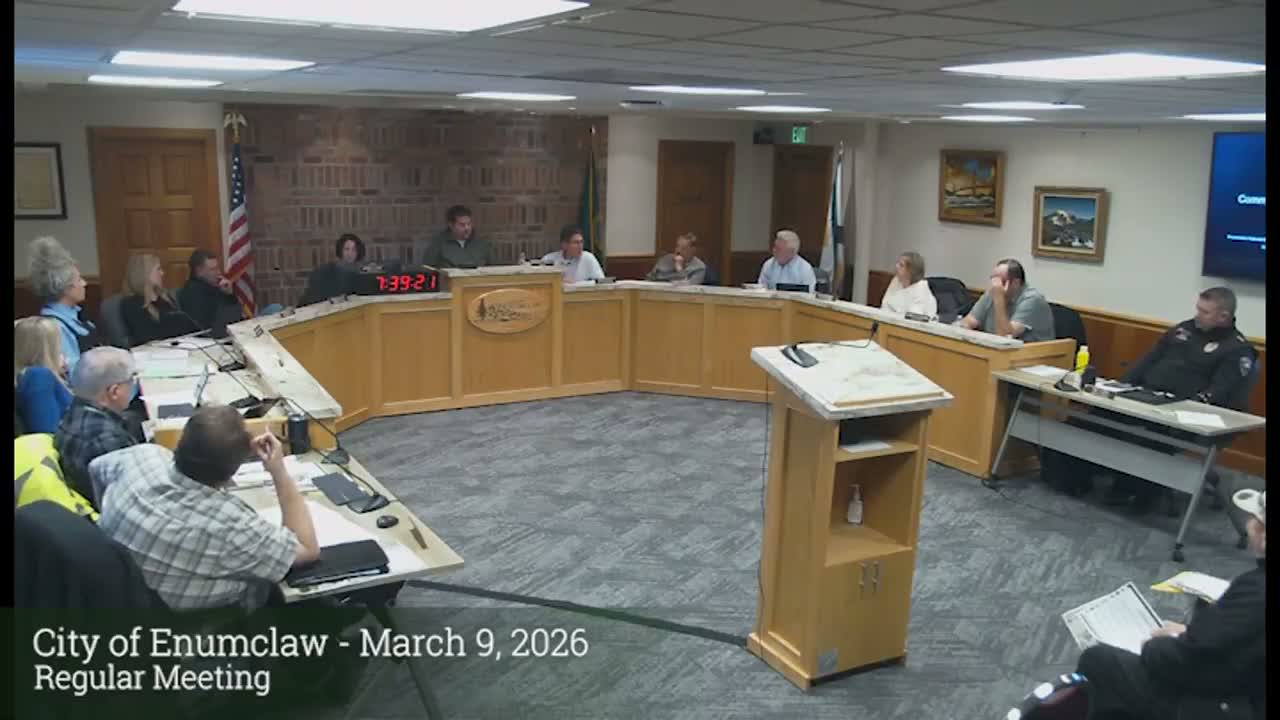
City Administrator Chris Searcy gave an informational workshop March 9 explaining how Washington’s Climate Commitment Act (CCA) affects Enumclaw’s municipal natural‑gas utility and outlining choices the city may face.
Searcy described the CCA as a state cap‑and‑invest program that requires covered entities to obtain allowances equal to their yearly greenhouse‑gas emissions. He said municipalities become "covered entities" when average emissions exceed 25,000 metric tons in the baseline period; Enumclaw’s average emissions for 2023–2025 were described on the record as just over that threshold. "We are just marginally over the threshold of being pulled into the program," Searcy said, noting the city could aim to be under 25,000 for every year of a compliance period to exit the program.
Searcy explained no‑cost allowances provided by the Department of Ecology start from an emissions baseline and are reduced over time (the staff description said the no‑cost allowances phase down by about 7% each year and the share required to be consigned to auctions rises until reaching 100% in 2030). Staff also described how auction proceeds from allowances consigned to auctions can be used to offset customer bill impacts; low‑income customers are excluded from certain charges under the CCA rules discussed.
Searcy said the city’s initial CCA cost was about $250,000 in 2023 and that figures have risen, with estimates in the presentation for recent years around $400,000 and the possibility that annual compliance costs could exceed $1,000,000 depending on carbon prices and market linkage to California. He warned that linking Washington’s market to California and Quebec could materially change allowance prices and that the state’s greenhouse‑gas reporting delays and pending litigation make demand and price forecasts uncertain.
Searcy identified policy options for council consideration: pursuing full cost recovery for new developments, seeking legislative carve‑outs or alternative compliance paths with other municipal gas utilities (example: Ellensburg), or applying for grants for decarbonization planning. He recommended council take time to review the information and return to the topic in May for follow‑up questions and possible policy guidance.
Council took no immediate action but voted to continue outreach and discussion at a future agenda date.