Goshen County School District #1 board warned of budget squeeze amid state funding-model changes
Loading...
Summary
Board trustees reviewed a preliminary 2026–27 budget laden with uncertainties after state funding recalibration: a drop in funded students, a mandated average-teacher-salary increase, new restrictions on insurance and interest-earnings funding, and a $260,000 dual-enrollment shortfall that could come from newly created instructional-silo dollars.
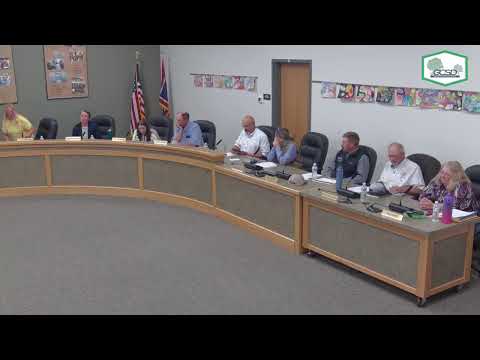
The Goshen County School District #1 board held a special meeting and work session on April 7 to review a preliminary 2026–27 budget that trustees were told contains “more unknowns” than any the presenter has seen in 18 years.
Marcy, the presenter at the board work session, said the legislature changed how school funding is calculated and that the district’s two-year average daily membership (ADM) is projected at 1,576 students versus an actual projection of 1,570; its prior-year ADM was 1,581 and a three-year average had been 1,603. “The reduction that we will see in funding based upon students, as of right now, is 27,” Marcy said, adding that each student is worth between $15,000 and $18,000 in the funding model.
The legislature also created an "instructional silo," a categorical allocation limited to certain instructional salary objects. Marcy listed staff categories covered by the silo — elementary, middle and secondary instruction, gifted and talented, ELL, CTE instructors and instructional facilitators — and emphasized that some roles (special education positions, nurses, librarians and counselors) are not funded in the silo. She said the silo can cover regular and temporary salaries, FICA and insurance for those positions but cautioned trustees that many technical details were still being clarified with the Attorney General’s office.
Trustees asked how the district would fund dual and concurrent enrollment tuition overruns; Marcy said the district anticipates about $260,000 in overrun this year and that any funds not received through BOCES or an additional allocation "can come out of this silo." Board members questioned whether counselors could be partially funded by the silo for that work; staff said counselors serving in an advisory (non-instructional) role likely would not fall under the silo for that time.
Marcy outlined several other changes that reduce local flexibility or shift costs: a change in how health insurance is allocated (year 1 based on participating employees using the state plan employer contribution; year 2 based on district actuals capped at the state employer contribution), a reduction in the portion of districts’ interest earnings returned by the state (the presenter estimated roughly $175,000 less), and a move to quarterly reimbursement for out-of-district special-education placements (which will make revenues look atypically high next year, she said).
Personnel costs were a central concern. Marcy said the legislature mandates that teachers be paid the model average teacher salary; the district’s average teacher salary was presented as $71,750 while the model average was $74,004.22, and Marcy said the district is projected to need a 5.5% increase to the certified base schedule to meet that mandate. She provided cost estimates tied to those movements: about $426,000 for instructional-silo certified staff to reach the 5.5% target, $286,000 for certified administrators and extra duty, and roughly $203,000 to raise classified staff by 5.5% (approximately $1/hour).
Health insurance remains the largest unresolved item. Marcy said one estimate for the retiree subsidy under the state health plan is about $1,100,000; under that scenario the silo could be fully expended and the non-silo portion could be negative roughly $525,000. She described alternative plan and split options that the district is evaluating but emphasized that incomplete information from the state and related agencies leaves several outcomes possible.
The presenter also flagged current-year variances the board should note: out-of-district special-education placements were budgeted at $715,000 but are now projected closer to $1,100,000 (an overspend), technology spending will require an increase (presented at $425,000), and the district plans to buy new cameras for buses at about $475,000 (Marcy said transportation work is generally reimbursable). The district’s reported cash reserves are roughly 14.7%; PRE-97 funds of about $775,000 will be included in the cash-reserve calculation going forward, affecting the reported reserve percentage.
Board members repeatedly pressed whether answers would be available before the finalized June budget. Marcy and trustees said the district’s carryover reserves are sufficient to "get through this year," but they emphasized that sustainable solutions beyond the short term are uncertain and depend on outstanding clarifications and decisions at the state level. Chair said at one point “this is not all doom and gloom,” noting the carryover provides short-term breathing room while staff and trustees seek clarity.
The board discussed the numbers in detail and asked staff to provide additional cost breakdowns at a follow-up meeting; several trustees asked for clarified figures to be available at the next session. The board later voted to enter executive session(s) to discuss wages and a separate governance/complaint matter (see separate article on the executive sessions).