Energy Secretary Chris Wright urges 'massively more energy' for AI, highlights Genesis mission with AMD's Lisa Hsu at ARPA‑E summit
Loading...
Summary
U.S. Energy Secretary Chris Wright told an ARPA‑E audience the country must produce far more energy to power AI and lift living standards, and touted a DOE‑lab‑industry 'Genesis' mission and rapid plans for large compute systems in partnership with AMD.
U.S. Energy Secretary Chris Wright told an audience at an ARPA‑E summit that the United States must produce "massively, massively more energy" to power artificial intelligence and expand global living standards, and described a fast‑moving partnership with national laboratories and private firms to accelerate computing infrastructure.
Wright, who opened the moderated session with AMD Chair and CEO Dr. Lisa Hsu, framed energy as foundational: "Energy is life. The absence of energy is poverty, despair, reduced opportunities, and ultimately death." He said the Department of Energy's role is to remove constraints — from permitting to grid capacity — so private investment can build data centers and other infrastructure faster.
The secretary characterized recent decades' energy policy debates as politicized and said some past investments amounted to "malinvestment," while also saying climate change "is a real thing." He framed decisions about energy around "humans and math," urging investments that deliver the largest net benefits.
Dr. Lisa Hsu emphasized compute efficiency across hardware, software and algorithms as "a first order consideration" for scaling AI. Hsu and Wright both said current AI growth is limited by power availability; Hsu said the industry still lacks enough power to support projected compute needs, and Wright added private companies "can't build data centers to drive America forward fast enough because they can't get enough power."
Both speakers described the "Genesis" mission as a national‑lab and industry collaboration to concentrate compute power and accelerate scientific discovery. Wright and Hsu cited partnerships with Oak Ridge National Laboratory and Lawrence Livermore National Laboratory and named two systems — Lux and Discovery — as examples of recent collaborations. Wright said the effort had moved faster than he expected and that the team was "on track to have something under that 9 month time frame that's gonna accelerate scientific discovery." Hsu and Wright said the partnership model aims to make research capabilities more widely useful and commercially viable over time.
Wright pointed to recent gains in fossil fuel production—saying U.S. oil production has tripled and natural gas production "more than doubled" over roughly 20 years and that those two sources account for about 72% of U.S. primary energy—then contrasted that with what he described as stagnation in electricity generation and rising costs. He argued the administration's priority is to make the electricity sector "dynamic" and better able to serve rapid advances such as AI.
On the grid, Wright said AI can help operators extract additional reliable dispatchable power from existing systems through smarter operations and new connections, not only new generation. He stressed that permitting and regulatory environments should be more welcoming to the "massive investments" required.
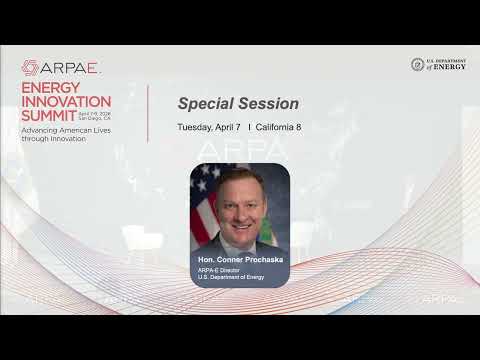
The session closed with Wright urging entrepreneurs to treat their work as a mission, and with ARPA‑E Director Connor Prochaska asking the audience to support the partnerships between industry and national labs. No formal policy actions or funding votes were recorded in the session transcript; speakers described a combination of ongoing partnerships and plans to accelerate deployment of large compute systems within months.
The remarks combined policy advocacy (accelerate permitting and grid modernization) with program‑level announcements about public‑private collaborations; Wright and Hsu repeatedly framed their proposals as efforts to speed scientific discovery and commercialize lab‑driven advances.