Get Full Government Meeting Transcripts, Videos, & Alerts Forever!
Get email alerts on the Inclusionary Housing topic
No spam. Unsubscribe anytime.
Alameda planning staff outlines inclusionary-housing options as developers press for lower in-lieu fees
Summary
Planning staff presented options to revise Alameda's inclusionary housing requirements, proposing a 15% baseline and modeling a $100,000-per-unit in-lieu equivalence; board members debated fee structure, affordability terms and feasibility, and a waterfront developer urged a $10/gsf in-lieu option to keep a project financeable.
Planning staff on Monday presented a draft update to Alameda's inclusionary housing ordinance that would give developers multiple compliance options, shift some emphasis to low-income rental units and use a range of fee and unit-mix models to preserve housing production amid high costs.
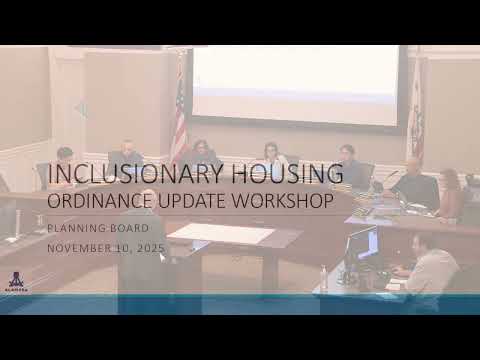
"I'm Steve Buckley. I'm the Planning Services Manager, and I'll be making the presentation tonight," Buckley told the Planning Board, framing the update as a check-in before the item moves to City Council. Staff said AB 1505 and regional guidance (OBAG IV) provide a policy baseline — including a commonly-used assumption of roughly 15% inclusionary when expressed as a citywide benchmark — but emphasized that feasibility and nexus analysis remain central to ordinance design.
The presentation described two ways of calculating developer obligations: a per-square-foot subsidy for rental projects and a per-unit cost for ownership projects. Staff used a working equivalence of roughly $100,000 per affordable unit as a planning benchmark and showed models in which current compliance costs roughly equate to about $18 per square foot for some rental prototypes. Buckley cautioned the numbers are round policy-direction markers, not final fee settings: "These are round numbers... they're not precise in any way," he said.
Board members pressed staff on specifics. Vice President Arisa asked whether affordability could be required in perpetuity; staff replied that 99 years or a "life of the project" term are typical ways to achieve long-term affordability. Other board members asked why rental fees were modeled per square foot while for-sale fees were shown per unit; staff said the spreadsheets convert between bases using average unit sizes so policy choices remain comparable.
The public comment period produced contrasting appeals. Andrew Rosenberg of Pacific Development, which is entitling a large waterfront "Foundry" project, said the site carries unusually high costs (seawall, remediation, soil stabilization) and "cannot support an on-site BMR requirement." Rosenberg asked the board to recommend a $10 per gross square foot in-lieu fee for the Foundry to make financing feasible; he said that level would be roughly $2.5 million (about $55,000 per unit) for his modeled project.
Public commenter Mitch Ball urged the board to close perceived loopholes for small or single-unit projects, recommending that accessory dwelling units (ADUs) and small developments of 2'to'10 units be reconsidered for exemptions so that the policy is fair across income groups.
Board members debated the core policy trade-offs: favoring on-site units versus in-lieu fees, tying fees to project costs versus setting flat per-square-foot rates, and whether the board should actively address project feasibility now or leave feasibility work for later phases. Board member Hong supported focusing rental inclusionary obligations on very-low and low-income tiers; board member Wang urged that the board be explicit if it is not addressing feasibility now and suggested a parallel temporary package to spur housing delivery during the current down market.
Staff said the matter will be presented to City Council the following week for feedback before Council-directed ordinance drafting and any additional fee-setting by resolution. No formal ordinance vote was taken by the Planning Board at this workshop.
Next steps: staff will brief City Council and return with ordinance language and any further feasibility analysis or proposed fee resolutions.