Get Full Government Meeting Transcripts, Videos, & Alerts Forever!
Get email alerts on the Operating Budget topic
No spam. Unsubscribe anytime.
Board adopts budget framework, restores staff and raises interpreter pay after lengthy debate
Summary
The board adopted the superintendent's FY27 budget as the basis for the board request, approved technical amendments and voted to restore a number of staff positions (including special‑education conversions, high‑school paraeducators and middle‑school media paraeducators), added multilingual teacher positions and science-of-reading training, and set interpreter pay to $40/hour after debate over summer programming and safety staff.
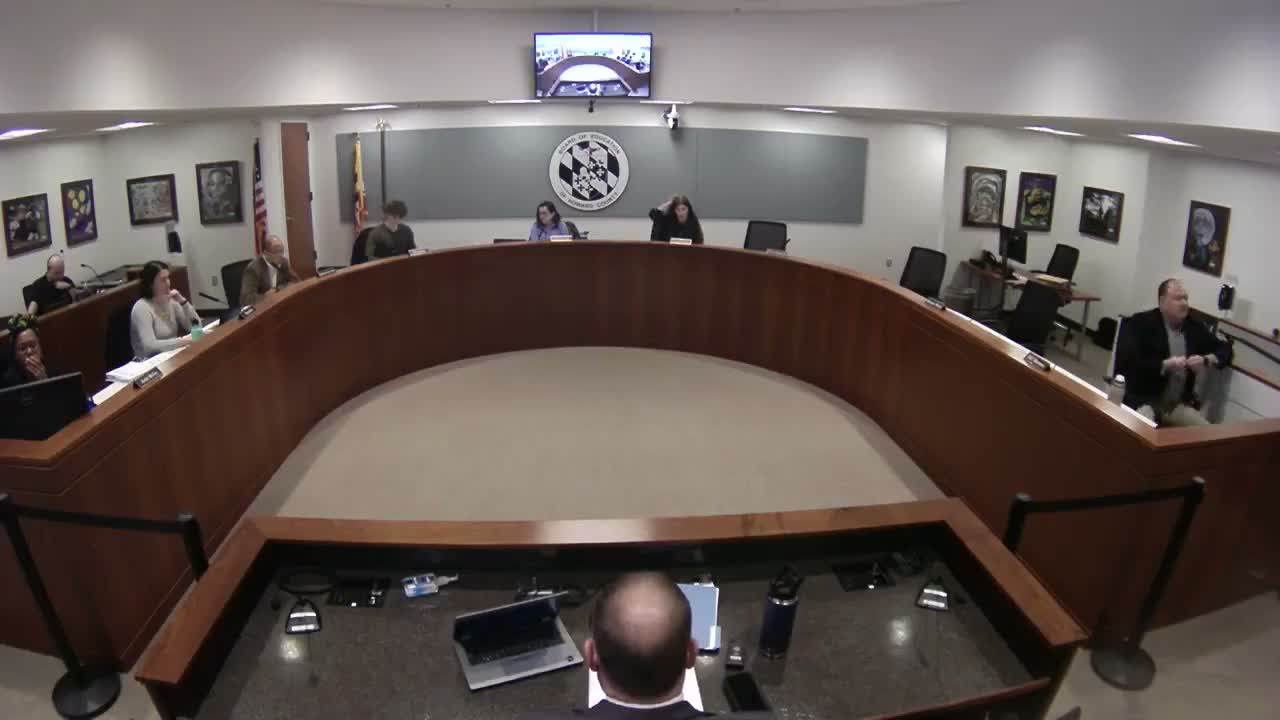
The Howard County Board of Education on Feb. 19 advanced the FY27 budget process by adopting the superintendent’s recommended FY27 budget as the basis for the board’s requested budget and approving multiple technical adjustments, restorations and additions to staffing and programs.
On procedural votes early in the afternoon, the board adopted the superintendent’s recommended budget as the board’s baseline budget for submission to the county (motion carried 7‑0). Staff then presented technical revenue and expenditure adjustments tied to updated state aid estimates, local revenue projections and a set of expenditure corrections. After a procedural amendment to separate a summer‑school revenue estimate, the board approved three technical revenue adjustments (including updated state aid and MSDE-related changes) and a package of technical expenditure adjustments. CFO Brian Hall summarized the net effect as roughly $7.6 million in additional capacity when combined with the other proposed restorations and additions.
Special education: Doctor Webster explained how a $4 million placeholder for special education would be converted into 43 specific positions (19 paraeducators, 16 special education teachers, 4 registered behavioral technicians, 2 social workers and 2 board‑certified behavioral analysts) to create nine new program classrooms and reduce caseload pressure. The board approved the conversion (motion carried 7‑0).
Staff restorations and additions: The board voted to restore several positions that had been proposed for removal in the superintendent’s original plan, including restoring 14 high‑school science paraeducator positions and a set of media paraeducators; the board also approved additions including 20 multilingual (English language development) teachers and systemwide science‑of‑reading training. Several restorations passed by roll calls documented in the meeting.
Interpreter pay and language access: After a discussion about market rates and interpreter availability, the board approved increasing the hourly rate for contracted interpreters to $40 per hour (motion carried 7‑0). Brian Bassett and Jennifer Williams told the board the requested change aimed to improve recruitment and retention; Jennifer Williams noted the system currently lists roughly 116 interpreters covering about 35 languages but that peak requests sometimes require outside vendors.
BSAP summer program debate: The board spent substantial time debating the BSAP (summer institute) tuition increase and whether restoring program capacity would lock the district into significant expenditures if enrollment proved lower following tuition hikes. Caroline Walker said revenue and scholarship assumptions were preliminary; multiple members raised affordability and access concerns. A motion to set BSAP tuition at $900 and treat the reduction in revenue estimate separately failed; the board later approved a technical revenue line that included summer tuition increase assumptions after separating the item for later calculation.
School culture and safety assistants: Another contentious item was the proposal to add six middle‑school 'school culture and safety assistant' positions. Opponents, including Ms. Watts, argued these roles could be used in ways that reproduce policing effects in schools and disproportionately affect students of color, calling them “a police officer without a gun.” Supporters cited data reported by administrators at pilot sites: reductions in referrals, suspensions and altercations. A motion to remove the six‑position addition failed (motion results 3‑3‑1), and the board asked staff to compile more quantitative and student-centered feedback (surveys or focus groups) before final decisions in May.
What this means: The board’s votes advance a FY27 request that includes restorations and targeted additions while preserving options to adjust after final state aid numbers are released in May. Several items remain contingent on final revenue and the county executive/council funding decisions. Staff will prepare score sheets and a budget resolution for final board adoption at the Feb. 26 meeting.
Representative quotes: "The OBRC recommends returning the 14 full time equivalent high school science paraeducators...unless and until a clear documented implementation plan...is presented," OBRC member Lanan Xu told the board. On interpreter pay, the board heard that "at $30, of our surrounding districts, we're at the lowest rate," Brian Bassett said, arguing for market adjustments. And in a pointed critique of the safety assistant proposal, Ms. Watts said she viewed the role as "a police officer without a gun," underscoring the equity concerns animating that debate.
Next steps: Staff will finalize score sheets reflecting the board’s adopted motions and reconvene Feb. 26 to vote on the final board-request budget for submission to the county.