Get Full Government Meeting Transcripts, Videos, & Alerts Forever!
Get email alerts on the Capital Budget topic
No spam. Unsubscribe anytime.
Board picks Built-to-Learn plan that blends renewal projects and school renovations after equity debate
Summary
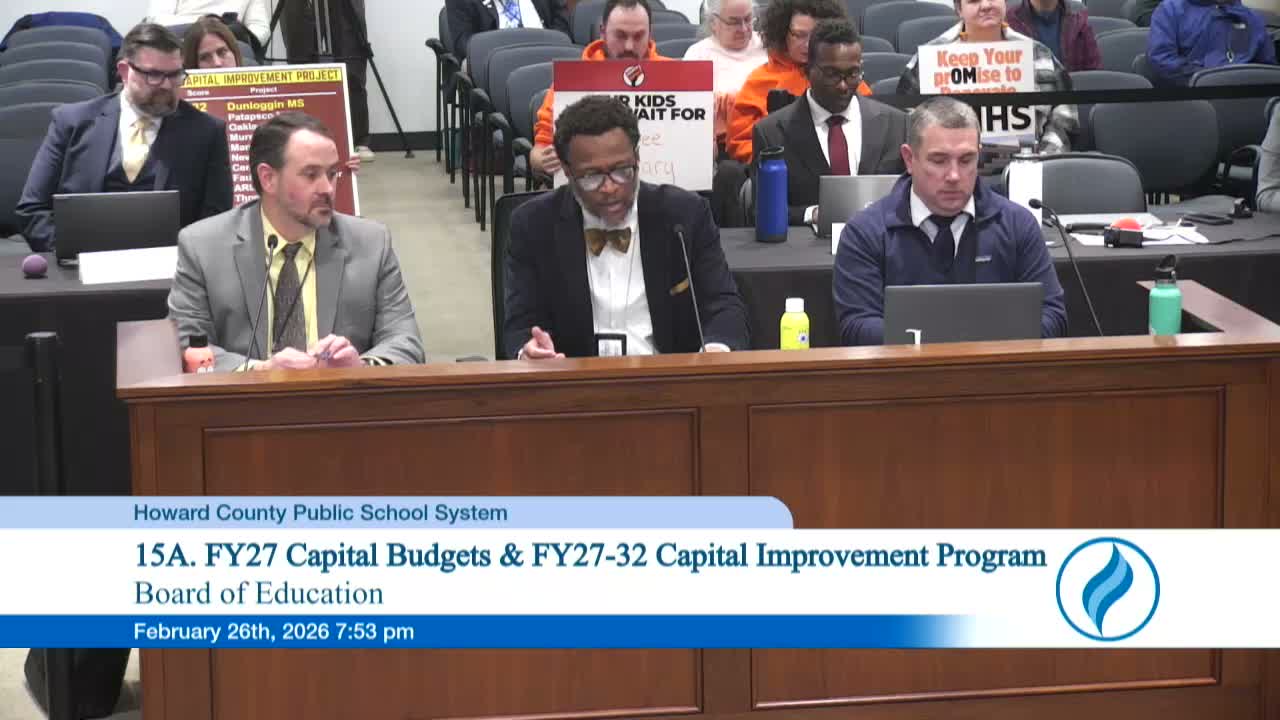
After a lengthy debate about equity, facility age and state funding rules, the Howard County Board of Education adopted Alternate Plan 1 (using remaining Build to Learn funds for a mix of projects) and approved the FY27 capital budget and 10‑year long-range plan; votes on these measures were 5–2.
The Howard County Board of Education on Feb. 26 adopted a Built to Learn Act plan (Alternate Plan 1) after extended discussion about project priorities, equity and the state’s eligibility rules. Staff presented three alternate plans that would deploy an estimated $75.5 million in remaining state Build to Learn Act funds across renewal, HVAC and larger renovation projects; each plan required different local funding commitments over subsequent years.
Staff explained a recent change in the state’s approach to eligibility (the ‘gross area baseline’): the state now ties participation for renovation square footage to demonstrated capacity need, reducing state participation for some projects where enrollment has declined. That shift in methodology was a driving reason staff prepared alternative plans for the board’s consideration.
Board members debated whether to prioritize large high-school renovations (Oakland Mills High School, Centennial High School) or to distribute funding across multiple renewal/ HVAC/ middle- and elementary-school projects. Members who favored prioritizing Oakland Mills and other larger renovations cited the school’s age, deferred maintenance, mold and equity concerns; members favoring the board-proposed list argued for a data-driven ranking that surfaced schools with urgent deferred maintenance across the county.
After votes, the board approved Alternate Plan 1 (motion carried 5–2), then adopted the FY27 capital budget and the FY27–36 long-range plan (each motion passed 5–2). Staff will submit the FY27 capital and long-range plan to the county. The record shows follow-up work: feasibility studies, programmatic assessments, and design-phase funding will proceed per the board’s direction.