Get Full Government Meeting Transcripts, Videos, & Alerts Forever!
Get email alerts on the Wetlands Pond Expansion topic
No spam. Unsubscribe anytime.
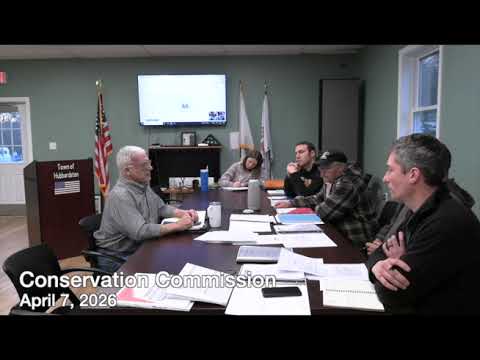
Hubbardston commission continues review of proposed pond expansion at 231 Garden Road
Summary
The Town of Hubbardston Conservation Commission continued a public hearing on Thomas Christopher’s notice of intent to expand a pond at 231 Garden Road after finding the meeting had not been properly posted; commissioners requested DEP clarification and detailed StormTech design and plan updates before voting.
The Town of Hubbardston Conservation Commission on April 11 continued a public hearing on a notice of intent filed for 231 Garden Road by Thomas Christopher that would expand an existing pond for canine training purposes.
Chair Brian Larochelle opened the item by reading the hearing notice under the Wetlands Protection Act (MGL ch. 131 § 40). The project representative explained that DEP issued a superseding positive determination after a prior local negative determination and that the work — because it includes excavation in a Zone 2 — also implicates local groundwater protection rules. The representative said the team had coordinated with Gardner planning staff and DEP reviewers and presented the commission with site photos, a narrative and a proposed StormTech subsurface system to replace existing detention basins.
Commissioners pressed for plan-level details. Commissioner Brian Larochelle said he could not find StormTech chambers, counts or locations on the plan and read DEP’s comment that “the applicant should provide details on the proposal, including, but not limited to, how the proposal meets the structural stormwater BMP specifications found in the Mass Stormwater Handbook,” and show locations and limited work areas in updated plan sheets. The project representative responded that the narrative described the StormTech approach but that the chamber layout had not been drawn yet and offered, if the commission preferred, to proceed without the StormTech element because the cost had not been estimated.
The meeting also addressed whether the constructed pond itself constitutes a resource area under the Wetlands Protection Act. The presenter said the pond was created in 2017 and that the proposed work would expand an existing water body while using silt fence, wattles and similar erosion controls to protect adjacent wetlands. The presenter also described the soils used in earlier site restoration — a blended short-paper-fiber and biodegradable sludge mix previously approved by the board of health — and noted updated statewide concerns about PFAS/PFOS that have since tightened reuse regulations; he recited the waiting periods the project had observed historically (30 days for grazing, one year for above‑ground food crops, three years for in‑ground crops) and said current site uses are limited to grass.
The commission did not close the hearing. Larochelle announced the panel had not properly posted the meeting notice in advance and therefore “we’re actually not able to close any hearings tonight,” and commissioners agreed they needed public-comment opportunity and additional documentation before a final vote. Commissioner Chris Turner moved to continue the hearing to the commission’s next meeting, and the motion was seconded and approved by voice vote.
Next steps: the commission asked the applicant to submit plan sheets that show the proposed subsurface StormTech chambers, sizing and locations; to update Form 3 and the NOI narrative to quantify resource‑area alterations; and to seek clarification from DEP on whether the pond itself or the work in its footprint is the regulatory focus. The matter will return to the commission at its next posted meeting with an opportunity for public comment.