Appeals panel weighs whether decades‑old racist conduct may inform Danielson v. Seattle Children’s hostile‑work‑environment claim
Loading...
Summary
An appellate panel heard arguments over whether earlier racist comments and a reported pattern of conduct can be considered under the Washington Law Against Discrimination when related acts within the three‑year statute of limitations are disputed; counsel for both sides debated the unitary‑act theory and whether the trial record contained sufficiently similar, timely acts. The court took the case under advisement.
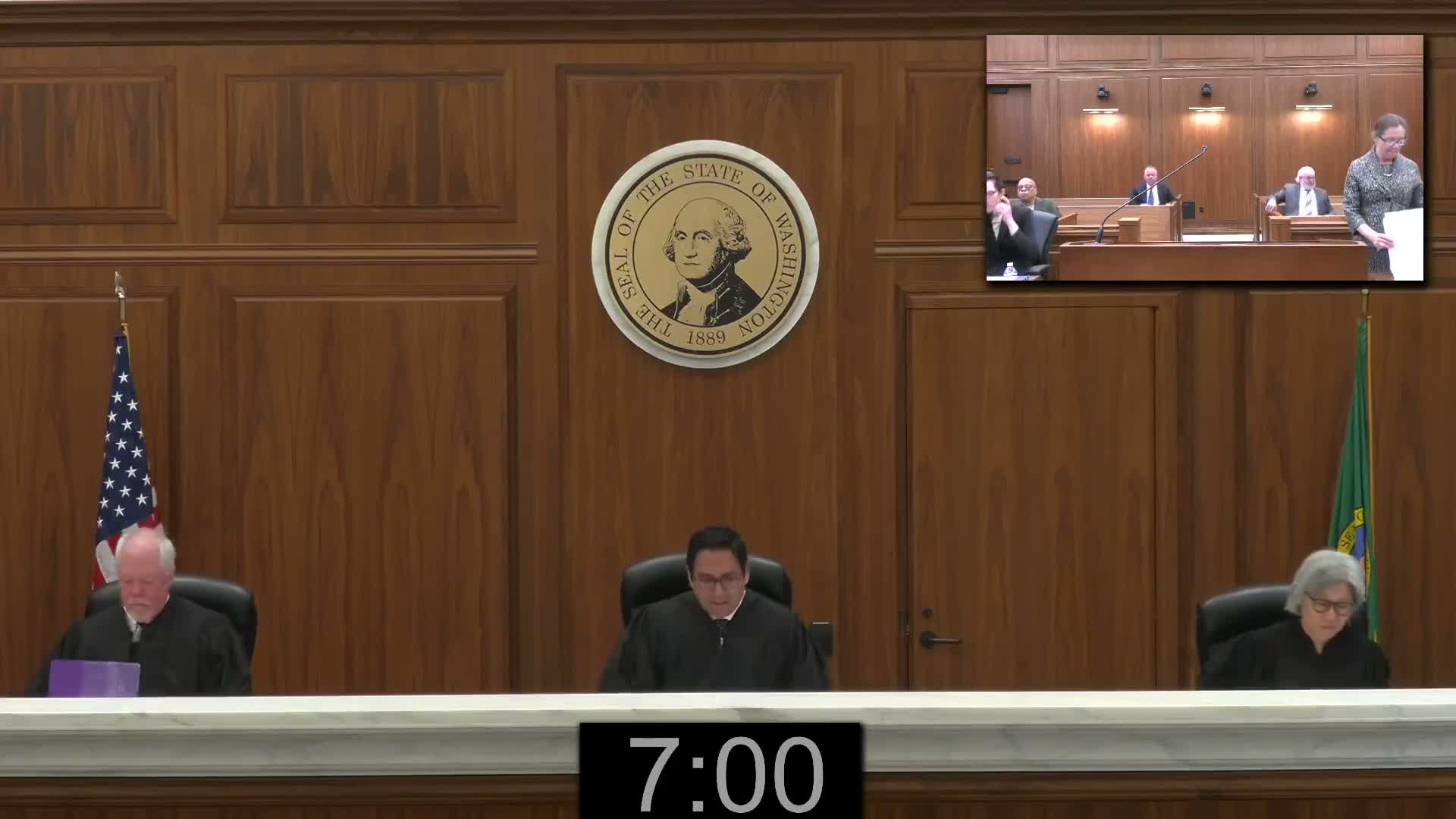
An appellate panel heard oral argument in Danielson v. Seattle Children’s over whether evidence of racist conduct that occurred years before the filing deadline can be considered by a jury under the Washington Law Against Discrimination.
Catherine Smith, counsel for Seattle Children’s, told the panel the statute of limitations requires that any older conduct admitted under the unitary‑act theory be “similar in kind” to an act occurring within the three‑year filing period and warned that a looser rule would effectively eliminate the limitations period. “We cannot allow individuals to go back 20 years,” Smith said, arguing the trial record lacked the specific, timely acts necessary to sustain a hostile‑work‑environment claim.
Jennifer Bennett, counsel for Dr. Danielson, urged the court to defer to the jury’s verdict and to the totality‑of‑the‑circumstances inquiry. Bennett said the jury rejected the hospital’s defensive framing and pointed to multiple witness statements in the record describing colleagues who treated Danielson as less capable because of his race and to a pattern of incidents that, she argued, the jury could reasonably link to later acts. “This is a totality of the circumstances inquiry,” Bennett said, adding that decades‑long hostile‑work‑environment claims often build from many incidents of varying severity.
The panel questioned both sides closely on the legal line between a unitary unlawful employment practice and a series of unrelated, historic remarks. The court pressed defense counsel on whether a one‑time epitet—admitted in the record as having been used in 2007—could be considered by a jury if there were other, related hostile acts within the limitations period. Smith acknowledged the earlier instance but said the governing case law requires at least one related act during the three‑year period to preserve timeliness.
Bennett cited precedent she said supports admitting prior conduct when it bears some relationship to later, timely acts and noted record citations she said document repeated complaints and a failure by leadership to investigate. She told the court Dr. Danielson had been demoted after raising concerns about racist practices and pointed to a Covington Burling review and other record pages as evidence of a continuing pattern.
The panel also examined whether a line in closing argument—where counsel said “money doesn’t fix racism” and asked the jury to bring accountability—amounted to reversible passion that could have prejudiced the verdict. Bennett responded that the hospital did not object at trial and thus waived the point, while defense counsel argued any single emotive sentence did not meet the standard for reversal when not timely preserved.
In rebuttal, Smith argued the jury’s award reflected a damages calculation that, in her view, was unsupported by objective evidence of altered employment conditions since July 2020, and she renewed her contention that the claim should have been dismissed on summary judgment. The panel asked whether the court or a jury should ultimately decide whether record allegations were sufficiently specific and related in kind to permit admission under the unitary‑act theory; defense counsel said the court must decide whether the pleading and record show the requisite related act within the limitations period.
The panel took the arguments under advisement and submitted the case for decision; no ruling was announced from the bench.