Contested Camino Verde variances draw hours of testimony on traffic, fire risk and open space
Loading...
Summary
At a Santa Fe County hearing, hearing officer Taylor Hartstein heard hours of testimony on three variance requests for the Camino Verde project: reduced setbacks (25—to 10 feet), reduced driveway separation (100—to 60 feet) and limited disturbance of slopes over 30% for erosion control. Opponents cited traffic, evacuation, water and habitat concerns; the officer will issue a recommended order within 15 business days.
Hearing officer Taylor Hartstein presided over a lengthy Santa Fe County hearing on case 265050, during which Samara Real Property's representatives sought three technical variances tied to a proposed Camino Verde subdivision north of Highway 599 at Camino La Tierra.
The variances under review would: reduce side and rear setbacks in the residential estate zoning district from 25 feet to 10 feet; allow driveway separation from the return radius of intersections to be reduced from 100 feet to 60 feet; and permit limited disturbance of slopes exceeding 30 percent for erosion-control work in specified locations. Staff recommended approval with conditions; Hartstein said he will issue a written recommended order with findings of fact and conclusions of law within 15 business days and that the Planning Commission is expected to consider the matter in May.
Why it matters: The hearing focused on whether the requested dimensional changes are narrowly tailored technical fixes or whether they would permit clustering that changes the semi-rural character of adjacent neighborhoods, increase traffic through a single access corridor, and pose fire-safety or ecological risks. Opponents argued the requests are "self-created" by the developer's design choices and should be denied or postponed pending further review; proponents and the applicant said the variances enable clustering that protects steep slopes, preserves contiguous open space and supports public trail access.
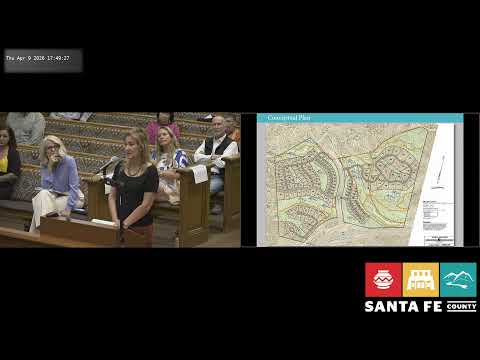
Samara Real Property's lead presenter, attorney Jennifer Jenkins of Jenkins Gavin, said the technical variances are limited in scope and accompany a conceptual plan (which the hearing officer noted is an exhibit, not before him for final approval). Jenkins described a proposed 158-lot subdivision on roughly 304 acres, with about 50% of the site proposed as dedicated open space and an 18-unit affordable housing commitment. "We are only proposing 158 lots," Jenkins said, and added that the applicant has voluntarily adopted a 50% lot-coverage limit to prevent oversized homes that some neighbors fear.
Staff analysis: Kenneth Quintana presented staff's review against the Sustainable Land Development Code (SLDC) variance criteria and recommended approval of the three variances with conditions. Staff read a revised condition limiting disturbance of slopes exceeding 30% to erosion control and to necessary utility, drainage, slope-retention and access work allowed by the SLDC.
Opposition themes: Dozens of neighbors, HOA leaders and technical speakers raised similar objections. Common points: - Traffic and evacuation: Multiple speakers said Camino La Tierra is a single constrained access for thousands of nearby homes and called the proposed driveway separations and the planned roundabout inadequate for peak and construction-period flows. William Whitney, representing the Towner Road Association, said the traffic-impact analysis used questionable trip-generation inputs and urged denial or a continuance for additional study. - Fire risk and public safety: Several speakers cited wildfire risk and evacuation choke points. A local resident who identifies himself as La Mariposa HOA's emergency-preparedness chair disputed the ISO rating cited by the applicant and warned that more homes would stress evacuation routes. - Code and procedural concerns: Speakers argued the variances are effectively being used to achieve a higher density through open-space bonuses and that some required technical materials (a current TAC letter) or proper posted notice may be missing or deficient; at least one commenter asked that the hearing be rescheduled to correct notice-placement concerns. - Environmental and habitat impacts: A certified wildlife biologist raised concerns that fragmenting pinyon-juniper habitat with roads and lots would degrade connectivity and long-term habitat viability, arguing that preserved open space must be contiguous and functional to protect wildlife.
Applicant response: The development team presented technical counter-arguments. Civil engineer Orlin Gedet Ortiz testified that there is no universal 100-foot AASHTO driveway-separation standard and that a 60-foot separation meets sight-distance and safety needs for this layout. The team also described erosion-control measures (rock check dams, Zuni-bowl-style features, native-vegetation stabilization) for arroyo head cutting and noted a preliminary community wastewater plan had been submitted for review.
Next steps: Hartstein closed oral testimony, reiterated that his recommendation will be issued in writing within 15 business days, and noted the Planning Commission is tentatively scheduled to hear the case in May. The hearing record remains the primary basis for his recommended order.
The hearing produced extensive written and oral comment on technical engineering, public-safety, environmental and procedural grounds. Hartstein and staff said they will consider the voluminous written submissions and the testimony when preparing the recommended order.