Get Full Government Meeting Transcripts, Videos, & Alerts Forever!
Get email alerts on the Kings Landing topic
No spam. Unsubscribe anytime.
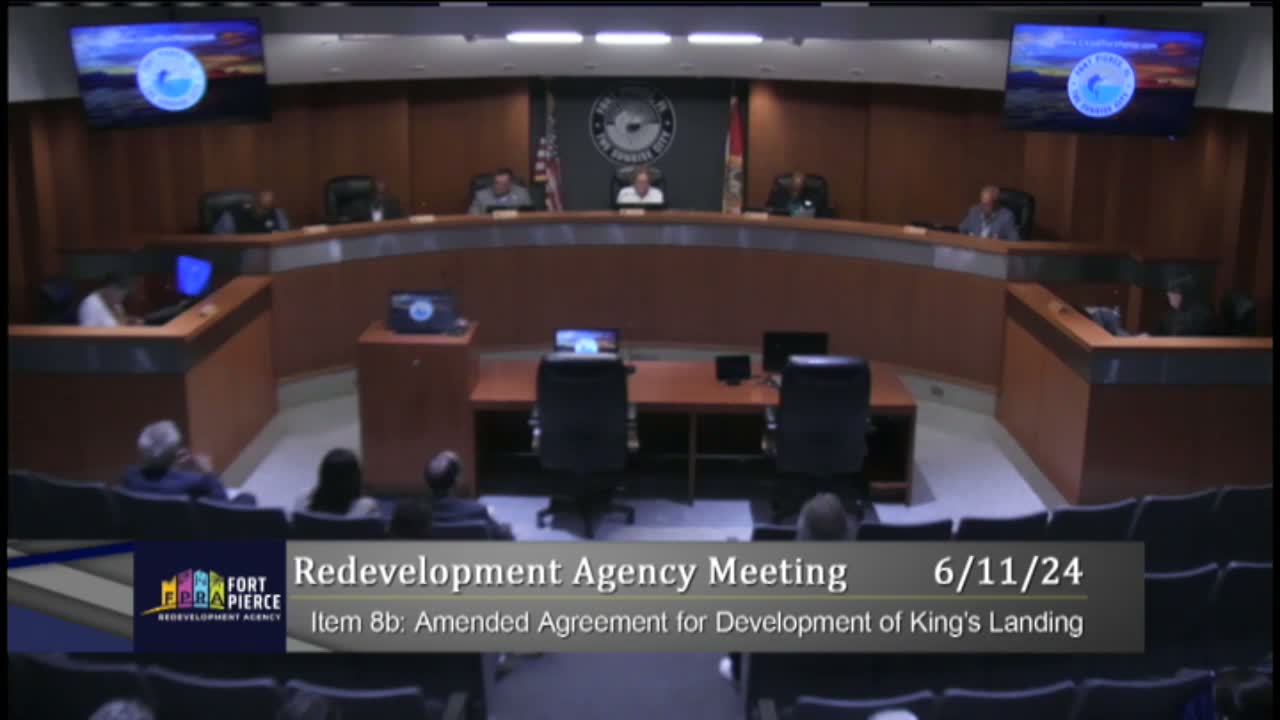
Fort Pierce redevelopment board gives developers 45 days to pursue joint venture on King's Landing
Summary
After hours of debate over financing, a disputed $1.1 million debris claim and a late-arriving document from a potential funder, the Fort Pierce Redevelopment Agency voted to give Audubon and an outside capital firm 45 days to try to form a joint venture; the board required weekly updates and declined to toll contract deadlines.
The Fort Pierce Redevelopment Agency on June 11 voted to give the developer of the stalled King’s Landing project a 45-day window to try to finalize a joint-venture agreement with a potential funding partner, while leaving the underlying contract and default timelines in place.
The action follows weeks of back-and-forth over an amendment that would extend construction timelines for King’s Landing and a dispute over a debris-removal reimbursement Audubon submitted for $1,100,000, which city staff said was inconsistent with earlier documentation showing $170,000 had been paid. Commissioner Broderick moved the measure; Commissioner Jay Johnson seconded it. The motion passed by roll call with a 4–1 vote (Commissioner Gaines opposed).
The board’s decision is intended to give Audubon and Harbert Realty Services — a company the board heard described in a letter and subsequent conversations as capable of supplying financing and taking a majority stake in the project — a limited opportunity to reach an agreement that would keep the hotel-and-mixed-use project moving. Scott Hawkins, counsel for Audubon’s client, told the board that the MOU and related materials reflect “a commitment of over a $100,000,000” from the funder and that Harbert had been identified as a lead construction/financing partner.
Why it matters: King’s Landing is a multi-phase waterfront redevelopment that commissioners said could take years to revive if litigation over the developer agreement proceeds. Several commissioners framed the vote as a calculated, short-term risk to avoid a potentially much longer pause that would leave property idle and taxable revenue unrealized.
What the amendment and dispute involve: City staff and the developer proposed timeline extensions and a conditional release mechanism tied to milestones in the amended and restated development agreement. Audubon inserted a line-item claim for $1,100,000 to reimburse debris removal; city staff said that figure is inconsistent with earlier records. Commissioner Broderick described the invoice as “nonsense” and urged the developer and its potential partner to clean up the documentation within the 45 days.
Board concerns and safeguards: Commissioners pressed for verification that Harbert had been given full disclosure of contingent liabilities — specifically buyer deposit claims (public comment at the meeting referenced more than $1.5 million in prospective buyer deposits) and the unresolved debris claim — and asked for weekly status reports during the 45-day period. The board required immediate notification if the parties reached an agreement, and it clarified that the contract would not be tolled: default dates remain in effect but staff and commissioners agreed not to initiate reverter action while the 45-day window is underway.
What supporters and critics said: Commissioner Broderick framed the proposal as “an opportunity to pull this back from the brink of disaster” and said Harbert had the funding capability to execute the project. Multiple commissioners said they were frustrated by late disclosures and by an invoice that lacked supporting detail; Commissioner Gaines voted no, saying he had not seen adequate documentation and objecting to the risk of sending default notices while negotiations continued.
Next steps: The FPRA will monitor weekly updates during the 45 days and reconvene to consider any agreed amendments or follow-up actions at the next scheduled FPRA meeting. Staff also will track related agenda items so the amendment and any implementing documents appear together when the board next takes formal action.