Get Full Government Meeting Transcripts, Videos, & Alerts Forever!
Get email alerts on the Climate Commitment Act topic
No spam. Unsubscribe anytime.
City staff warns municipal gas utility faces rising Climate Commitment Act costs, asks council for policy guidance
Summary
City Administrator Chris Searcy told the council the Climate Commitment Act (CCA) already pulls the municipal gas utility into regulated compliance and that annual allowance costs could rise into six figures; staff asked council to consider policy positions, program staffing and potential legislative alternatives.
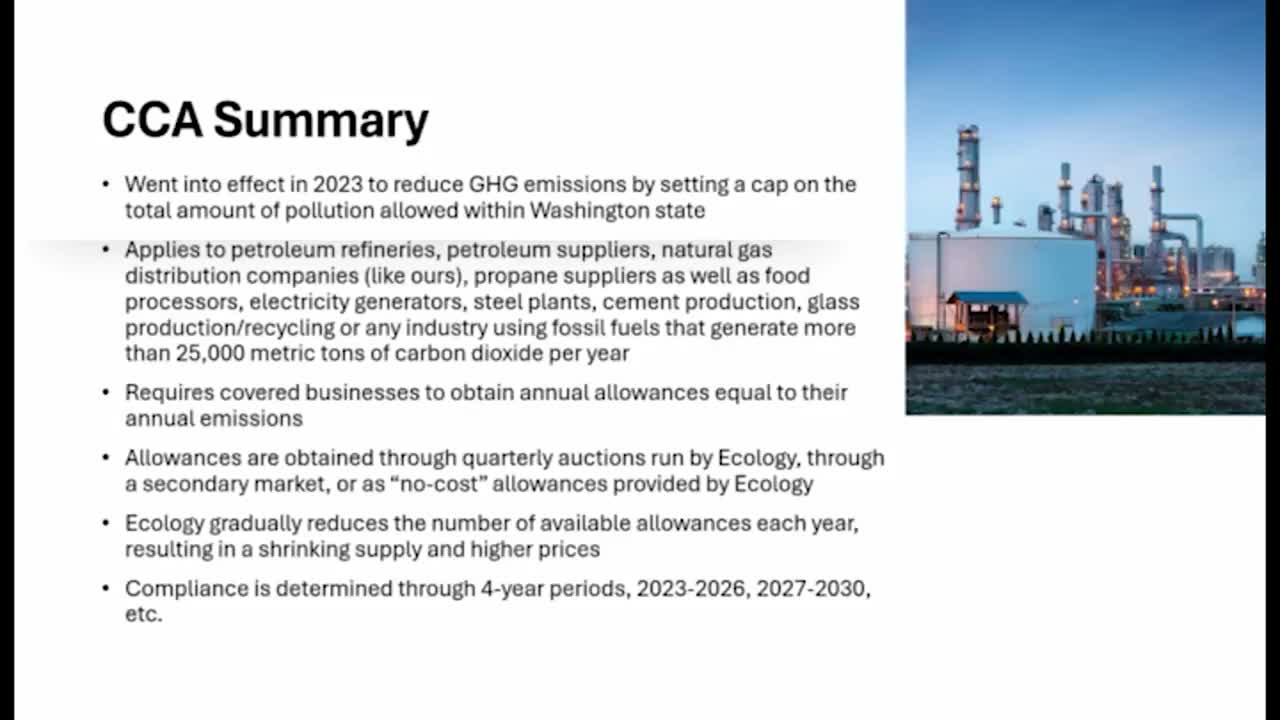
City Administrator Chris Searcy told the Uniontown City Council on March 9 that the state's Climate Commitment Act (CCA) already applies to the city's municipal natural gas utility and that the program's costs and market uncertainty are likely to grow.
Searcy said the CCA requires covered entities to obtain annual carbon allowances equal to their greenhouse-gas emissions and that the city's average emissions for 2023 —125 slightly exceeded the 25,000-metric-ton threshold that pulled the utility into the program. "We are just marginally over the threshold of being pulled into the program," he said, adding the city could only reliably exit by staying below 25,000 metric tons for every year of a four-year compliance period.
The city receives some no-cost allowances from the Department of Ecology, Searcy said, but the share of free allowances declines each year while the proportion required to be consigned to state auctions increases. That combination means the utility will need to purchase additional allowances on the open market as the program matures. "The main thing to keep in mind is we have to buy an additional amount that does cost, you know, out of pocket money," he said.
Why it matters: Searcy framed the workshop as an informational briefing to orient newer council members and to request future policy direction rather than an immediate vote. He said staff has been managing compliance to date but that reducing the city's emissions likely will require a dedicated program and additional personnel to plan and help customers convert away from natural-gas space and water heating.
Key details: Searcy described two customer classes under the program: legacy customers connected before July 25, 2021, who receive auction-proceeds offsets, and non-legacy customers connected after that date, who pay the full compliance cost. He said legacy-customer CCA charges have been in the single-digit cents per 100 cubic feet (about 5 —7¢ historically), while non-legacy customers face much higher per-unit charges (he cited approximately 23¢ early in the program).
Searcy said program costs so far have been modest but rising: "The first year was about $250,000 in 2023," he said, and more recent years approached a few hundred thousand dollars; projections, he warned, are uncertain because allowance prices depend on market linkage and state reporting that remain unsettled.
Council questions and staff options: Councilmembers asked about projected long-term cost trajectories and whether the city could seek legislative relief or an alternative compliance path with similar municipal utilities such as Ellensburg. Searcy said Ellensburg and Enumclaw (the two other municipal gas utilities in the state, he said) have discussed an approach that would place compliance funds into a restricted account dedicated to decarbonization planning rather than playing the auction market.
Next steps: Searcy asked the council to review the materials, confer with peers and return the topic to a future agenda (he proposed May) for possible policy guidance on whether to pursue an alternative compliance approach, seek grant funding for decarbonization planning, or direct staff to develop a local program to reduce gas load. No formal votes were taken on policy options at the March 9 meeting.
Quotes: "It is the law. We must comply with it," Searcy said. "But when we look at how do we reduce our load, we're talking about trying to find ways to get customers off our gas system or a portion of their use off our gas system."