Lifetime Citizen Portal Access — AI Briefings, Alerts & Unlimited Follows
Economic Matters Committee advances slate of bills, including blockchain land-record pilot and housing rule changes
Loading...
Summary
The Economic Matters Committee voted favorably on a broad slate of bills—mostly voice votes—advancing measures from blockchain-enabled property recordation to fair-housing conformity, a Maryland Futures Board, and several local and technical items; most passed with unanimous or near-unanimous support and will appear separately on the House floor.
The Economic Matters Committee on April 11 advanced a broad package of measures on a largely bipartisan, voice-vote docket, moving bills ranging from a blockchain pilot for land records to a state-level conformity of federal fair-housing standards.
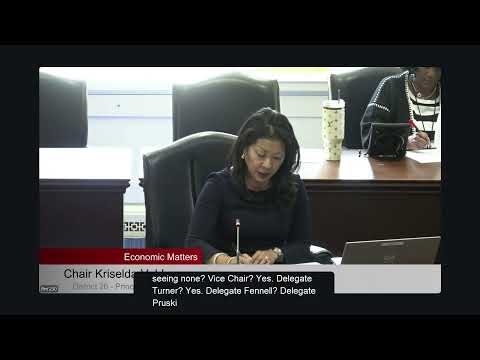
The committee’s chair opened the session and the committee treated voting list 18 as a consent calendar, which the panel approved without discussion. The committee then proceeded through voting list 17, taking up a series of separate bills that were each moved favorable and, in most cases, passed in committee.
Lawmaker B, who outlined several of the measures, described Senate Bill 168 as a conforming change to the House cross-file that would permit using blockchain technology for property recordation and verification and asked for two amendments: “Amendment number 1 is technical. Amendment number 2 [names] the Maryland Blockchain Association as an entity that SDAT will coordinate with when conducting the study,” the lawmaker said. The committee adopted the amendments and approved SB 168 in committee; the bill will appear separately on the House floor for individual votes.
On housing policy, Lawmaker B said Senate Bill 274 would align state law with current federal interpretations of discriminatory housing regulations by restoring language that discriminatory housing practices may be committed regardless of intent. “So literally, nothing changes in the context of how people operate today,” the lawmaker said while urging amendment to match the House language. The committee amended and moved the bill favorable.
Other notable measures advanced included:
- SB 325: A housing-development bill described by Lawmaker E that grants a project a five-year vested right after a complete application is submitted and limits when jurisdictions may collect development excise taxes or impact fees; clarifying and technical amendments were adopted and the bill passed committee.
- SB 770: A bill creating a Maryland Futures Board within the Department of Commerce and a Maryland Futures Fund to finance recommended projects; the legislation requires the comptroller to study economic-growth trends for the board and sunsets the board after five years (2031). The committee moved the bill favorable.
- SB 818: A measure to create an advisory group to provide community input on redevelopment of the Stay Center site in Baltimore, increase transparency between the developer and local communities, and identify potential community benefits; the bill was described as having passed unanimously out of both committee and the Senate floor prior to the committee vote and was moved favorable.
The committee also moved several local or technical bills favorable, including provisions related to condominium and homeowners association training in Charles County (SB 573), insurance limitations in condo bylaws (SB 747), self-storage occupancy rules (SB 438), and consumer protections addressing unsolicited checks (SB 582).
Committee members and counsel noted limited debate on most items; on the condominium training bill members asked whether a statewide training requirement (if passed) would supersede or satisfy the local requirement, and counsel replied that overlapping requirements could be satisfied by a single training event. There were no recorded floor-level defeats in this session; most bills passed committee by voice vote with roll-call counts announced for committee records.
The committee concluded by noting that this was the last bill on today’s docket and that votes will continue tomorrow at a time to be announced.