Local presenters urge City of Austin to prioritize converting PDFs to accessible HTML
Loading...
Summary
Presenters from AIM Robotics and University of Texas demonstrated converting city PDFs into accessible HTML, saying properly structured HTML forms improve screen‑reader compatibility and recommending an inventory-and-priority approach; presenters noted rising lawsuits and cited remediation costs of roughly $5–$12 per page for manual services.
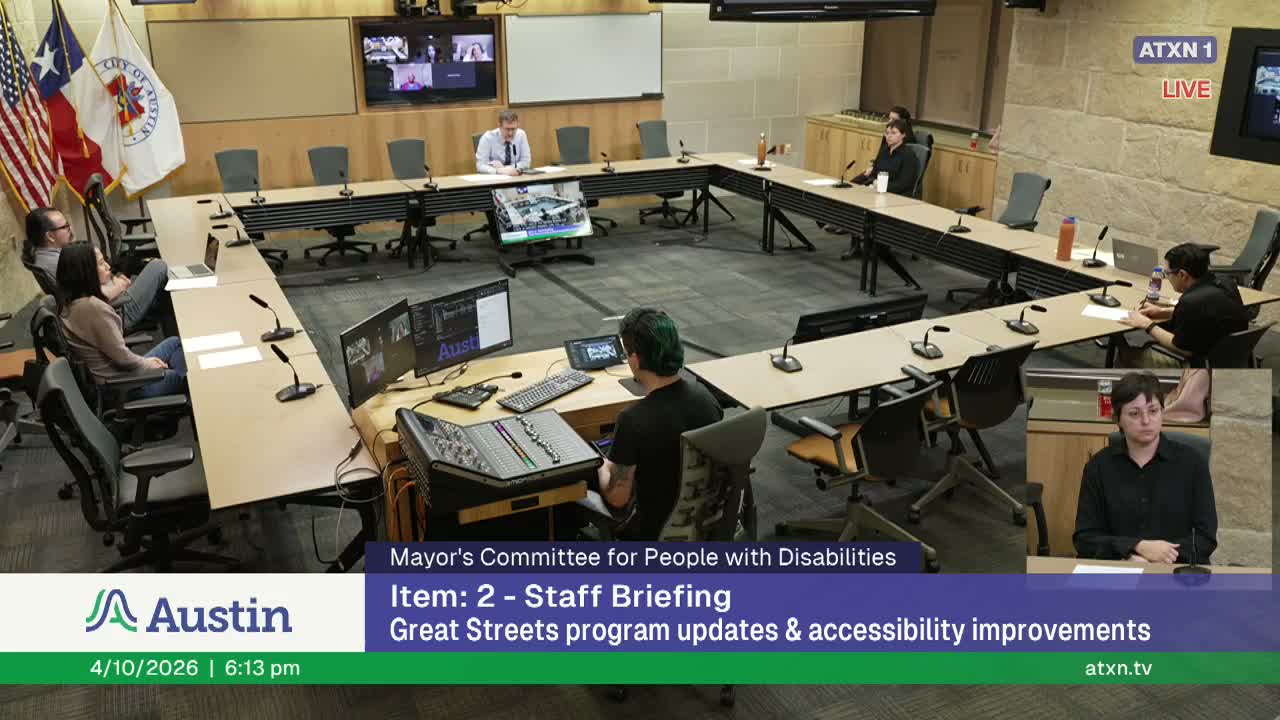
AIM Robotics representatives and University of Texas accessibility researchers told the Mayor’s Committee for People with Disabilities on April 10 that many City of Austin PDFs are functionally inaccessible to blind and low‑vision users and that converting critical forms to HTML could enable independent access and employment opportunities.
"PDF files are often inherently inaccessible," said Jackson Day, a digital accessibility researcher and University of Texas doctoral student, explaining that screen readers depend on semantic tagging and correct reading order; when a PDF is scanned or not properly tagged, a screen reader can produce jumbled or repeated output. "The HTML file that was generated is far more accessible to a screen reader than a standard PDF," he said.
Catherine Chen, the presenter representing AIM Robotics, described a local example in which a small-business owner said his daughter, who has low vision, could not complete city permit PDFs and therefore could not work for the family business. Chen and colleagues said they have used AI‑assisted tools to convert PDFs to structured HTML and recommended the city inventory public PDFs, prioritize high-traffic and employment‑critical documents, and consider a scalable conversion strategy that includes staff training to produce accessible documents going forward.
Presenters also cited broader urgency: staff referenced a widely quoted Adobe study estimating trillions of legacy web documents and said a large share are partially or wholly inaccessible; they noted rising digital-accessibility litigation and an upcoming Department of Justice‑related mandate that is increasing pressure on governments to act. A presenter estimated manual remediation costs for outsourced services at roughly $5–$12 per page, and argued that an inventory plus prioritized, AI‑assisted conversion would be a more affordable, scalable path.
Commissioner Chang asked whether the presenters had coordinated with City of Austin web services. Presenters said they had contact with the city accessibility lead and that the city planned in‑house efforts, but they urged that external, scalable options could accelerate remediation for high‑priority forms and reduce barriers for blind and low‑vision residents.
Next steps: presenters offered to follow up with city staff and the committee; the committee did not take a formal vote but requested further coordination and noted the recommendation to prioritize forms that create barriers to employment and essential services.