Lifetime Citizen Portal Access — AI Briefings, Alerts & Unlimited Follows
Austin planners outline Great Streets update, stress accessibility and funding questions
Loading...
Summary
Austin Planning told the Mayor’s Committee for People with Disabilities it completed an eight-month inventory of 230 downtown block faces for the Great Streets update, identified maintenance and accessibility gaps, and expects to seek council adoption in winter 2027; funding and expansion remain tied to developer participation and capital projects.
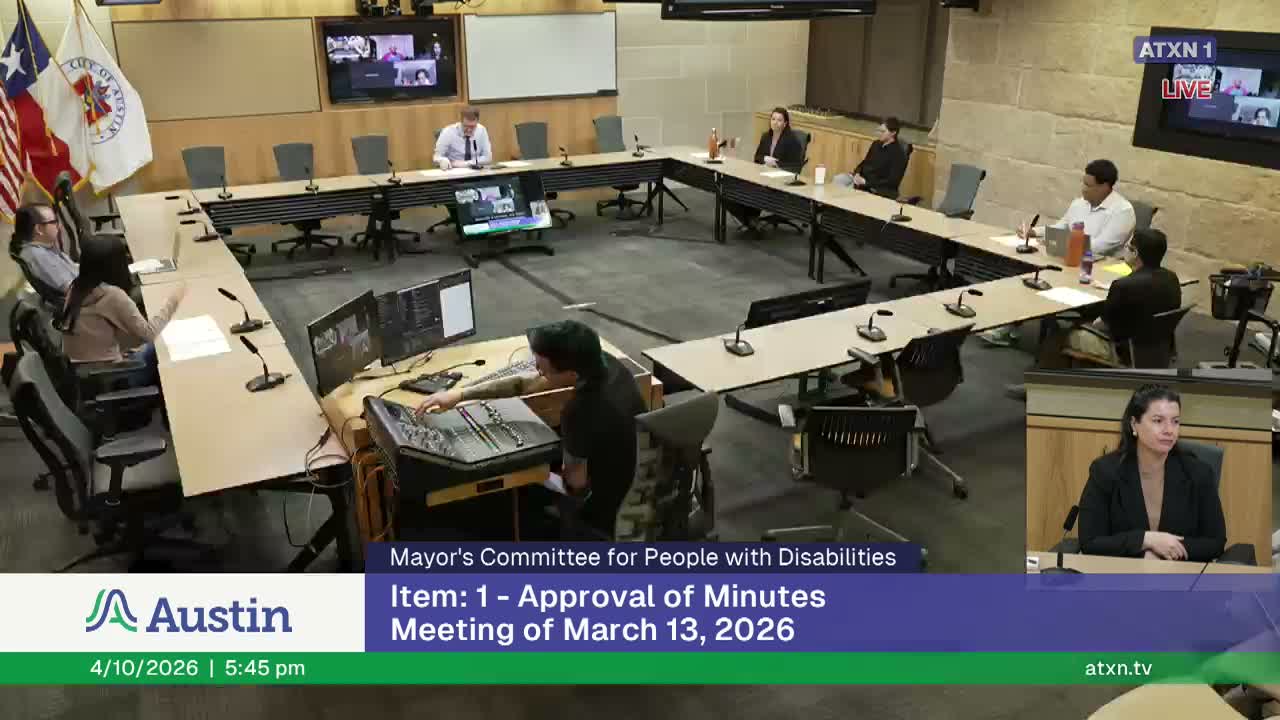
Austin Planning staff on April 10 briefed the Mayor’s Committee for People with Disabilities on an update to the city’s Great Streets program, describing an eight-month inventory and new standards aimed at improving downtown pedestrian experience and accessibility.
"We walked 230 block faces in downtown that where Great Street is already installed," said Jill Amezquah, principal planner in Austin Planning’s Urban Design Division, describing the existing-conditions analysis that informed the update. Amezquah said the inventory highlighted high-scoring assets such as lighting, bike racks and trees and recurring problems including worn benches and trash around receptacles.
The presentation framed Great Streets as a people-first, pedestrian-oriented program intended to support public life in downtown Austin. Amezquah said the update will consider new furnishings, pavement treatments and greater specificity around standards to ensure accessibility for people with visible and nonvisible disabilities.
A key implementation detail is funding and delivery. Amezquah told the committee the Great Streets program receives a dedicated portion of parking meter revenue, which staff cited as roughly $728,000 annually for program support, and that many installations have occurred because developers participate in the downtown density-bonus program and are required to install Great Streets elements as a condition of that program. Where developers do not participate, the city has a developer reimbursement program to incentivize installation.
Commissioners asked about the program’s geographic scope and its relation to other downtown projects. In response, Amezquah said the current Great Streets boundary is the Central Business District (Lamar to I‑35, MLK to Cesar Chavez) but noted there may be opportunities to expand to areas such as Rainey Street where downtown density-bonus projects occur. She also said urban design is coordinating with Project Connect and with the University Neighborhood Overlay process to align cross sections and pedestrian accommodations.
On outreach, Amezquah said staff have collected more than 1,000 comments to date (including a fall online survey with more than 300 participants and an open house of roughly 75 attendees) and distilled community input into 22 draft recommendations. She said the plan and standards will continue to be refined with a community advisory group and that staff aim to bring the draft to council for potential adoption in winter 2027 or January 2027 after additional briefings to boards and commissions.
Next steps: staff will refine the 22 recommendations with the advisory group, update cost and implementation analyses where needed, and return to advisory bodies and council as planned. No formal committee vote was taken on the plan at the April 10 meeting.