Get Full Government Meeting Transcripts, Videos, & Alerts Forever!
Get email alerts on the Budget 2024 25 topic
No spam. Unsubscribe anytime.
Public hearing opened on Travis Unified 2024–25 budget as CBO warns of rising special‑education and facilities costs
Summary
At a public hearing on the 2024–25 proposed budget, public commenter Mark urged investing reserve funds in short‑term Treasuries; Gabe, the district chief business officer, outlined revenue drivers, a modest statutory COLA, and a $6.5 million two‑year rise in special‑education contributions that will require roughly $4.5 million in expenditure reductions in coming years if trends continue.
The Board opened a public hearing on the proposed 2024–25 budget. Public commenter Mark urged trustees to invest portions of the district’s reserves in short‑term U.S. Treasuries to capture current yields, arguing the funds could produce significant earnings. Mark cited Education Code provisions on investing surplus district funds and gave an example calculation: ‘‘Invested in 1 month treasuries, the school district would yield $991,000… million dollars can't be ignored.’’
Gabe, the district’s chief business officer, framed the budget context. He said the state was facing a roughly $27.6 billion budget shortfall and that the district expected a statutory COLA of about 1.7%, which he estimated would add about $7.77 million to LCFF revenue next year. He explained that LCFF is the district’s largest revenue source (about 83% of general‑fund revenue) and that timing differences and possible state deferrals can create cash‑flow uncertainty.
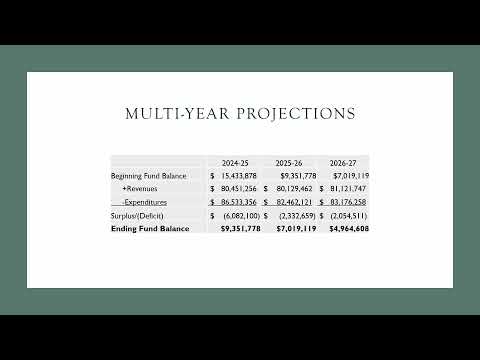
On expenditures, Gabe said the district projects about $70 million in unrestricted revenue and roughly $78 million when combined with restricted funds. He gave line items for the general fund: certificated salaries near $32.7 million, classified around $13.7 million and benefits around $19.8 million, with total expenditures the district estimated at about $86.5 million.
Gabe flagged a substantial increase in special‑education costs: the district’s contribution from the unrestricted general fund rose from approximately $10.1 million to $16.7 million over two years — a roughly $6.5 million increase driven by more students qualifying for services, higher required service hours, caseload maximums and scarce specialist staffing that often requires more expensive contracted services. He said that trend is forcing current deficit spending to cover special‑education costs and that, if it continues, the board will face difficult tradeoffs. “When 80 plus percent of your expenditures are personnel… there’s not much you can do,” he said, adding the district will try to manage impacts through attrition and careful prioritization.
Gabe also described facilities and capital pressures, citing repeated HVAC and chiller failures and a recent server‑room cooling failure that required temporary fixes. He presented a multiyear projection showing small deficits in 2025–26 and 2026–27 and told trustees that achieving the district’s minimum reserve will require about $4.5 million in expenditure reductions beginning next year. Trustees asked for follow‑up data, including a staff request to compare the percentage of base‑affiliated students with IEPs to non‑base students to better understand the district’s special‑education profile relative to the presence of Travis Air Force Base and David Grant hospital.
Next steps: the public hearing closed and the board indicated formal action on the proposed budget will come at the following board meeting (staff indicated the action would be taken next Tuesday). Staff committed to providing the requested spreadsheets and continuing to refine projections as final state budget information becomes available.