Stark County planning commission tables 303‑acre zoning decision after missed notice; neighbors raise noise, road and property‑value concerns
Loading...
Summary
The Stark County Planning and Zoning Commission heard a request to amend the future land use map and rezone 303 acres near Taylor for an agriculture‑focused industrial park but tabled action after staff discovered one landowner within the required 200‑foot notice area was not mailed. Supporters said the project would help local farmers; nearby residents warned of noise, traffic and property‑value impacts.
Stark County planners on April 2 heard more than two hours of testimony on a proposal to change the future land use map and rezone roughly 303 acres near Taylor from prime agricultural to general industrial with a planned‑unit development overlay, but they delayed any decision after staff discovered one landowner in the statutorily required 200‑foot notice area did not receive mailed notice.
The applicant, identified in the record as Ben ****, told the commission the project is intended to build local aggregation, segregation and light processing capacity for specialty crops — including identity‑preserved hard‑white wheat — so area growers can capture higher value for quality grain. “I wanna create a closer, higher quality connection to the products we make in Western North Dakota to the consumer,” Ben said during his presentation, describing hopper bins, a grain dryer and a single‑car (manifest) rail shipping plan for Phase 1.
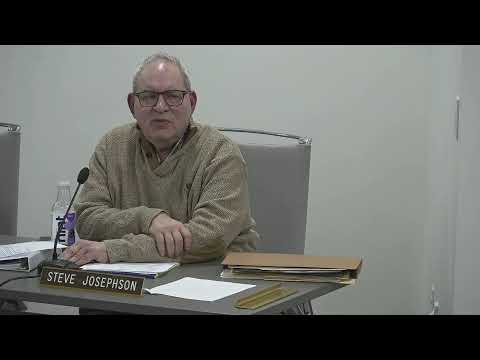
County planner Steve Josephson told commissioners staff recommends approval of both the future land use map amendment and the PUD rezoning in concept, noting the site’s access to rail, interstate, utilities and soil survey results that staff characterizes as not being prime agricultural. But Josephson said a notice mailing error — one landowner within the required notification distance was not mailed — meant the commission could not make a final recommendation and should table the formal vote until that person has been given time to respond.
The hearing surfaced sharply divergent views among neighbors. Resident Ashley Wycomb, who said she lives directly across Highway 10 from the proposed site, opposed the rezoning and said the family moved to that property recently with the expectation the area would remain agricultural. She described fears about nighttime train‑spur operations, repeated coupling and uncoupling noise and the effect on property values, air quality and safety: “A rail‑served facility is not just trains passing by. It involves the loading and unloading of railcars, the coupling and uncoupling of cars, and the repeated impact sounds … often at all hours of the day and night,” Wycomb said.
Supporters, including Jeff **** (identified in the record as the applicant’s father), framed the project as necessary economic infrastructure for area farms. “This is a way to keep us viable,” Jeff said, arguing the facility would preserve local agricultural jobs and provide identity‑preserving storage and shipment options that are absent in the region.
Residents also raised technical concerns: whether the City of Taylor had been consulted (staff said Taylor does not have an extraterritorial zoning area and the property falls under county jurisdiction), how wetlands and drainage would be handled (the applicant said a wetland delineation and mitigation plan were submitted to and accepted by the U.S. Army Corps of Engineers), and who would pay for road improvements for heavy trucks (the applicant said he is coordinating with the county road superintendent and expects developer‑led haul‑road agreements and upgrades where needed).
Several specific commitments were offered on the record: the applicant proposed a 200‑foot no‑building buffer around the property, planting three rows of trees along the north boundary, adherence to PUD use limits so unspecified industrial uses would require future public hearings, and a haul‑road plan to be coordinated with the county by November 1 for Phase 1. Ben also cited a small on‑farm glyphosate test — one sample that tested 9 parts per million and a controlled sample that tested 0 — as evidence that growers can produce low‑residue wheat but said system‑level incentives and local handling are required to make that commercially feasible.
Because of the notice lapse, the commission voted to table the items and set the next hearing for April 30 at 3 p.m. Staff and the applicant said the tabling will allow the missed landowner 10 days to be officially notified and respond. Josephson reiterated that any final approvals would be bound by the PUD conditions in the staff report and would require compliance with county, state and federal permitting, including wetlands mitigation and engineering approvals.
The commission adjourned after taking the procedural vote; no zoning change or formal recommendation was adopted at the April 2 meeting.