Lifetime Citizen Portal Access — AI Briefings, Alerts & Unlimited Follows
House committee hears mixed views on bill to make videoconference default for municipal adjudicative hearings
Loading...
Summary
A House committee reviewed House Bill 995 to add Article 4.009 to the Código Municipal, with the Federación de Alcaldes urging amendments to make videoconference optional and require funding identification while the Asociación de Alcaldes largely endorsed the measure if both videoconference and in-person options remain.
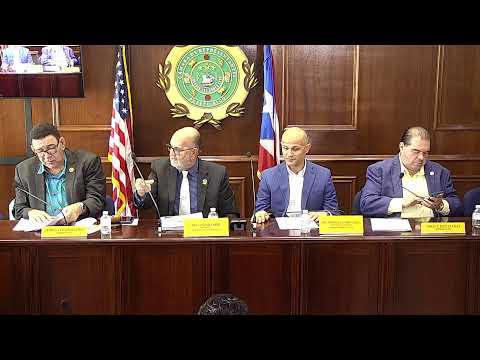
A House committee convened March 24 in Hearing Room 2 to consider House Bill 995, which would add Article 4.009 to Law 107 (the Código Municipal de Puerto Rico) to establish videoconference as the first option for municipal adjudicative hearings. The session included testimony from the Federación de Alcaldes de Puerto Rico and the Asociación de Alcaldes de Puerto Rico and questions from representatives.
Ricardo Rolón Morales, legal advisor to the Federación de Alcaldes de Puerto Rico, told the committee the federation opposes the bill as drafted because it "ignores the real cost of implementation" and would impose economic obligations on municipalities without identifying funding. Rolón Morales cited Article 1.007 of the Código Municipal to argue that any legislative measure that creates economic obligations for municipalities must identify resources to meet them.
Rolón Morales also said making videoconference the "first option" risks undermining municipal autonomy under Article 1.003 of the Código Municipal by substituting local administrative discretion with a uniform legislative rule. He warned that in some adjudicative cases—particularly evidentiary hearings—the quality of the proceeding may require in-person presence and that some municipalities lack in-house hearing officers or legal staff to implement the change effectively.
To address those concerns, the Federation recommended converting the proposed provision to a facultative (optional) mechanism so municipalities may adopt videoconferencing according to local realities; removing "first option" status and restoring discretion to the hearing officer; complying with Article 1.007 by identifying and allocating resources; expressly reaffirming municipal autonomy and allowing local regulation; and implementing a gradual, flexible pilot approach.
Verónica Rodríguez, executive director of the Asociación de Alcaldes de Puerto Rico, summarized the bill's operative text and described procedural safeguards included in the draft: the hearing officer would consider case complexity, the evidence to be presented and parties' circumstances; hearings may be suspended and rescheduled if a participant's disconnection cannot be restored within 15 minutes; municipalities would notify parties and publish applicable guidance on their portals; and videoconference hearings would be recorded and included in the case file to preserve the record for judicial review. Rodríguez said the Association "endosamos el proyecto" provided that both videoconference and in-person options remain available.
Several committee members voiced support for the bill's modernization goals. Representative Pedro Pellé Santiago said the measure is "versatile" and can speed municipal operations while safeguarding parties' rights. Representative Sergio Estévez Bello said videoconferencing can be especially useful during emergencies, allowing distributed municipal staff and offices to meet and coordinate.
The committee chair (name not specified in the transcript) pressed the Federation for empirical cost estimates; Rolón Morales said the Federation had no exact dollar figure but described practical implementation costs and capacity gaps based on practice. The chair asked the Asociación to provide, within five business days, the list of municipalities currently using videoconference tools and asked the committee to request a cost analysis from OPAR (the Office of Management) to determine whether the measure imposes economic costs that require identified funding.
No final vote was taken. The chair instructed the committee to seek an OPAR analysis and set a 10-day deadline for that report; the committee also asked the Federation and the Association to provide the additional information requested. The hearing adjourned at about 10:45 a.m.
Why it matters: The bill would change how municipalities conduct administrative adjudicative hearings across all 78 municipalities; supporters say it modernizes procedures and saves travel and time, while opponents warn of unfunded costs and threats to local discretion and due process.