Lifetime Citizen Portal Access — AI Briefings, Alerts & Unlimited Follows
House commission debates bills to exclude overtime from child‑support income; ASUME warns harm to minors
Loading...
Summary
At a March 30 public hearing, ASUME told the House Commission on Older Adults and Social Welfare it opposes two bills (C‑1140, C‑1161) that would exclude overtime and variable pay from the income used to calculate child support; labor representatives backed exclusion for workers who rely on variable pay. The committee requested a Department of Justice opinion and took no final vote.
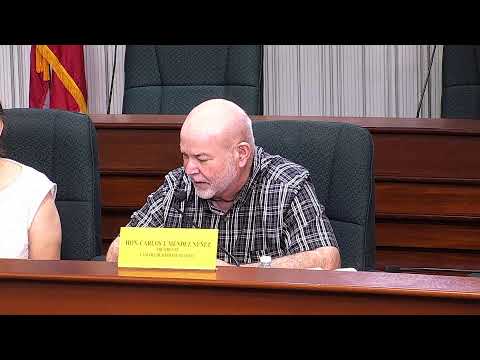
Representative Ricardo Chino Reyes Ocasio Ramos, president of the House Commission on Older Adults and Social Welfare, opened a March 30 public hearing on two measures that would exclude overtime and other nonrecurring pay from the income used to calculate child support (C‑1140 and C‑1161).
María del Mar Matteo, administrator of the Administration for the Sustenance of Minors (ASUME), told the commission the agency opposes approval of both bills. “Nuestra oposición a la aprobación de ambas medidas” was presented as the agency’s formal position, Matteo said, arguing that Puerto Rico’s governing statutes and ASUME’s mandatory guidelines already provide the proper framework for treating overtime: when overtime is regular and recurrent it may be included in income, but judges retain discretion to exclude sporadic or extraordinary pay in order to protect the child’s best interest.
ASUME cited Law 5‑1986 and the Code Civil’s protections for minors, and pointed to the agency’s mandatory guidelines (Regulation 95‑35, article 12) for the method judges and ASUME use to average or exclude variable pay. Matteo emphasized judicial discretion and case‑by‑case evaluation: when overtime is received consistently over a long period (ASUME described a typical test of roughly 36 months), it can be treated as part of income; when it is sporadic, a judge may exclude or average it to avoid distortions in the support calculation.
The Unión General de Trabajadores (UGT), represented by Edwin Méndez Cardona, supported C‑1140. “Las horas extras… no constituyen un ingreso fijo y permanente,” UGT argued in its presentation, saying many workers — including public employees — rely on variable pay to meet basic costs amid rising inflation. Carlos Vázquez, UGT vice president, added that overtime payments to police, paramedics and firefighters have in practice been delayed for long periods, making variable pay essential to household budgets.
Lawmakers pressed both sides on practical consequences and enforcement. Commissioners asked whether ASUME’s information systems can identify how often overtime is included in current calculations; ASUME replied the agency does not have an immediate filter to produce a precise case count but said it could attempt to compile relevant data and reiterated that mandatory guidelines are reviewed every four years and modifications or reviews of individual support orders may be requested at any time. ASUME also said support‑order modifications are effective from the date the court issues them and that withholding orders to employers remain the central enforcement mechanism.
The hearing included detailed exchanges on possible safeguards — for example, averaging overtime over a multi‑month period, specifying thresholds for recurrence, or creating legislative language that preserves judicial discretion. Several members urged caution to avoid creating classifications that would benefit some workers while harming the child’s economic protection. One committee member asked for a formal legal opinion from the Department of Justice on the constitutional and statutory reach of the bills; the chair confirmed the committee had requested that memorial and said it would evaluate the measures responsibly.
No vote was taken. The committee adjourned after receiving testimony and the requested legal opinion.
The principal next steps reported to the committee were ASUME’s offer to try to provide case‑level data, and the commission’s request to the Department of Justice for a formal opinion on the bills’ legal implications.