Get Full Government Meeting Transcripts, Videos, & Alerts Forever!
Get email alerts on the Staffing Cuts topic
No spam. Unsubscribe anytime.
Students, teachers and parents urge Board to restore media specialists and science paraeducators
Summary
Dozens of students, teachers and community members told the Howard County Board of Education that proposed FY2027 cuts to high‑school media specialists, middle‑school media paraeducators and science paraeducators would reduce literacy supports, eliminate labs and weaken safety and equity across schools.
Dozens of students, teachers and community members urged the Howard County Board of Education on Feb. 12 to reverse proposed FY2027 staffing cuts that would reduce high‑school media specialists, middle‑school media paraeducators and science paraeducators.
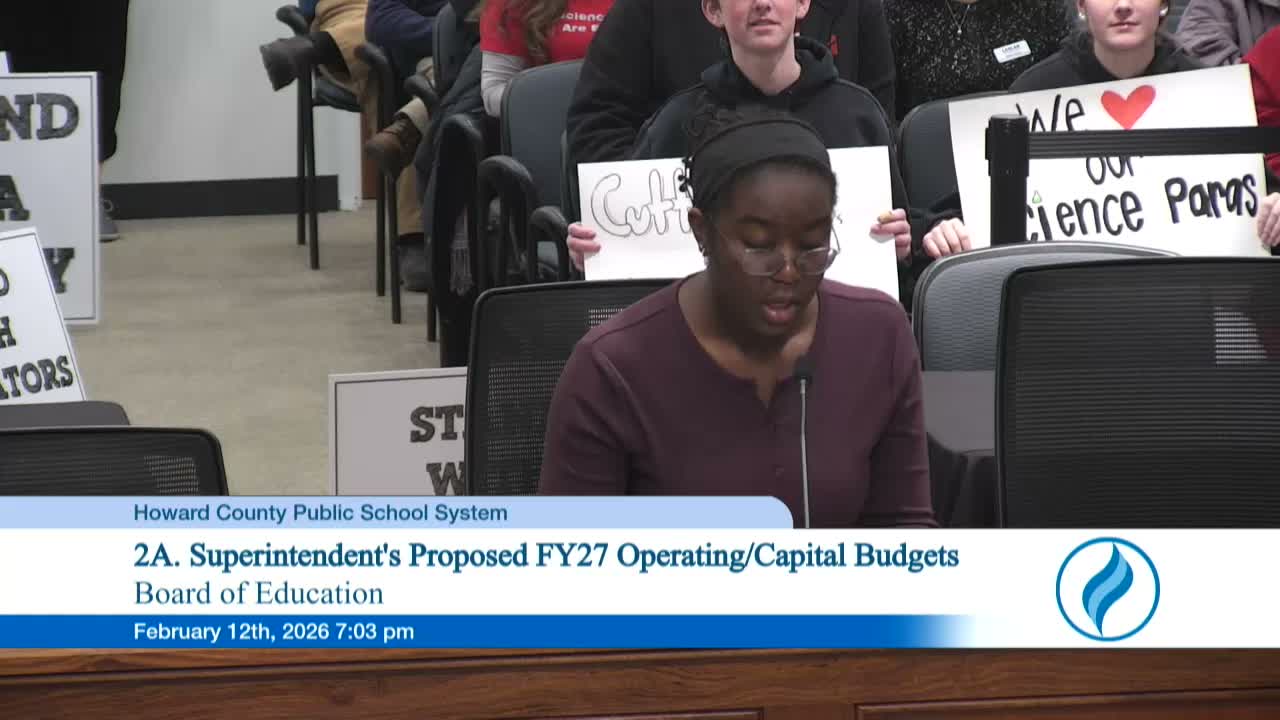
Fatou Savage, a senior at Reservoir High School, told the board she opposed removing a high‑school media specialist, saying librarians teach media literacy, host book talks and provide critical technology support. "Without the space created by a lovely media specialist, I would not have the courage to speak in front of you all today," she said, describing Ms. Lee and Ms. Tipton as daily supports for students.
Matthew Roush, a Howard High senior, said media specialists at his school — including Ms. McGuigan — transformed an underused media center into a community space and offered emotional and technical support that paraeducators cannot replace. "Media specialists do more than manage resources or troubleshoot technology. They help build the culture of a school," Roush said.
Teachers and paraeducators framed science paraeducator positions as essential safety and compliance roles. Jessica Stockham, a science paraeducator at Centennial High School, said the title understates the work: the role includes laboratory management, chemical preparation, oversight of equipment and safety controls. Stockham told the board that eliminating 14 science para positions would cost just under $1,000,000 but would remove a single point of accountability and create inequitable outcomes across schools.
Multiple students described hands‑on labs that depend on trained staff to prepare chemicals, set up equipment and dispose of hazardous waste safely. River Hill students and teachers said some labs require days of preparation and careful cleanup; without specialists, teachers would be asked to perform those duties in addition to full teaching loads. "Without our science paraeducators, labs would cease to run efficiently," one student testified.
Media‑center staff described operational impacts they are already seeing after prior reductions: tens of thousands of fewer book checkouts at the elementary level after last year's cuts, daily tallies of dozens of device repairs and depleted capacity to supervise open media spaces during duty‑free lunch periods. Media paraeducators also emphasized support for multilingual learners and special‑education students who seek device help at higher rates.
Speakers asked the board to use updated county revenue projections and state aid increases to restore positions, arguing the short‑term savings would harm student learning, safety and equity. Community testimony repeatedly linked the staffing questions to core program delivery — literacy, lab access, and compliance for advanced and AP coursework.
The board did not vote on the budget at the hearing; the public hearing concluded after more than two dozen speakers. Members of the public said they plan to continue advocacy with the board and at upcoming county funding forums.