Lifetime Citizen Portal Access — AI Briefings, Alerts & Unlimited Follows
House Higher Education committee lays over HF4608 after testimony on limits for remedial college credits
Loading...
Summary
The House Higher Education Committee heard testimony on HF4608, a bill that would cap time in remedial/developmental college courses and require disclosure and reporting. Testifiers described student harms and institutional concerns; the Office of Higher Education flagged staffing and fiscal impacts. The committee laid the bill over for further work.
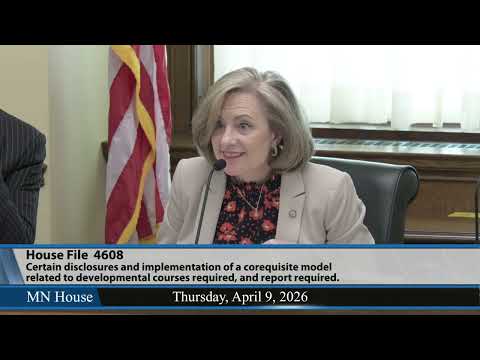
The House Higher Education Committee laid over House File 4608 after a hearing in which advocates described students spending years in remedial, noncredit-bearing courses and state officials warned the bill would create new workload and regulatory needs.
Representative Allen, speaking for the bill’s author, told the committee HF4608 is intended to increase transparency, efficiency and student success by capping the time students can spend in remedial or developmental courses and by requiring students be informed when those courses do not count toward their degree. "Students can spend months, even years, taking courses that don't move them towards graduating," Allen said.
Jane Grotman, executive director of the International Institute of Minnesota, testified she has counseled a client who accumulated 59 credits in developmental education while trying to complete a 40-credit nursing program and later discovered the remedial credits did not count toward the degree. "She was distraught and heartbroken," Grotman said, urging the committee to limit protracted remedial enrollment to one semester and to require clear notice that such credits do not apply to degrees.
Mark Grant, a communications instructor at Dakota County Technical College speaking on behalf of Minnesota State faculty, told the panel he shares concerns about students getting stuck but warned a statutory one-size-fits-all approach could undermine open-access missions and local practices. "Limiting the tools of the professionals who create and deliver this curriculum is not the approach that we think should be taken," Grant said, noting co-requisite models and small targeted classes can work on some campuses but that student needs differ by location.
Committee members pressed for detail. Chair Liebling and others questioned a statement quoted from an Office of Higher Education report — that students who do not enroll in developmental education complete postsecondary programs at double the rate — saying the comparison may reflect different starting populations rather than a causal effect. Grotman responded that she was citing the Office of Higher Education’s report and said research shows prolonged sequences of developmental courses correlate with higher dropout rates because many students have family or work obligations.
Andrew Wald, general counsel and director of compliance at the Office of Higher Education, testified the office currently lacks curriculum oversight authority and staff expertise the bill would assume. Wald said implementing the bill would likely require an amendment to the office’s statutory authority (testimony cited statute 136801) and a fiscal increase; his office provided a fiscal note to the senate estimating roughly $146,000 for one curriculum specialist position and about $13,000 for the reporting/dashboard work. "We don't currently have the expertise," Wald said.
Members raised other operational questions: why the bill emphasizes a one-semester corequisite for English rather than math or other subjects; whether required referrals to adult basic education programs would be equivalent to college preparatory programs; and whether signed written acknowledgments could become administrative hurdles for working students. Representative Hicks, working from prior experience with transition programs for students with disabilities, supported transparency but cautioned against placing excessive reliance on placement tests as gatekeepers.
Representative Allen closed by noting the bill had already been laid over in the Senate and that the author would be amendable to changes; members said they were "listening intently" to concerns and could consider portions in omnibus drafting. The committee announced HF4608 would be laid over; the transcript records the motion and disposition but does not include a roll-call vote.
The committee did not adopt policy language or a final vote on HF4608 at the hearing; next steps would depend on amendments and follow-up work with the Office of Higher Education and stakeholders.