Lifetime Citizen Portal Access — AI Briefings, Alerts & Unlimited Follows
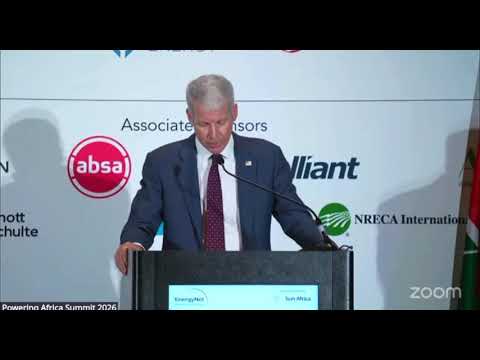
U.S. Energy Secretary Chris Wright urges action on clean cooking in Africa, criticizes costly renewable investments
Loading...
Summary
At a Washington, D.C. conference, U.S. Secretary of Energy Chris Wright urged practical, people-focused energy investments for Africa—highlighting clean cooking fuels and last-mile delivery—and criticized past large-scale renewables spending as costly and of limited global emissions impact, as he described it.
U.S. Secretary of Energy Chris Wright told a Washington, D.C. conference audience that improving lives in Africa requires practical, people-centered energy investments, placing particular emphasis on expanding access to clean cooking fuels and solving last-mile delivery challenges.
"I love Africa, and I love Africans," Wright said at the opening of his remarks, framing the conference as a call to action rather than a forum for rhetoric.
Wright described modern energy as the driver of major gains in global health and prosperity, and urged decision-makers to evaluate energy choices through two lenses: human outcomes and the math of return on investment. He argued that priorities should be set by what will most improve people's lives in each country.
Speaking about large-scale renewable deployments in wealthy nations, Wright said, "we spent $10,000,000,000,000 on wind turbines, solar panels, batteries, and all the huge transmission lines" and that those sources "provided last year 2.6% of global energy. 2.6%. In The United States, 3%." He framed those costs as having limited effect on global greenhouse gas totals while raising energy costs for some communities.
Wright emphasized that African countries should decide their energy pathways without outside paternalism. He praised recent national statements from African governments on clean cooking and said that expanding access to clean cooking fuels is "the greatest bang for the buck," asserting that more than 80% of Africans lack clean cooking today.
On implementation, Wright highlighted the practical difficulty of last-mile distribution—"How do you get an LPG canister to remote villages in a sustainable economic way?"—and said addressing business conditions, capital availability and distribution networks would be essential. He also noted parallels in the United States, pointing to rural reliance on LPG and urban pipeline networks.
Wright invited partnerships to accelerate action, saying he was "proud to have Raj and the Rockefeller Foundation as our partners" and calling for measurable progress in the coming year and decade. He closed by repeating his personal commitment to the work.
The speech was a policy exhortation, not a presentation of specific new U.S. commitments or rule changes; Wright repeatedly framed his remarks as urging action and partnership rather than announcing formal U.S. government programs during the address.