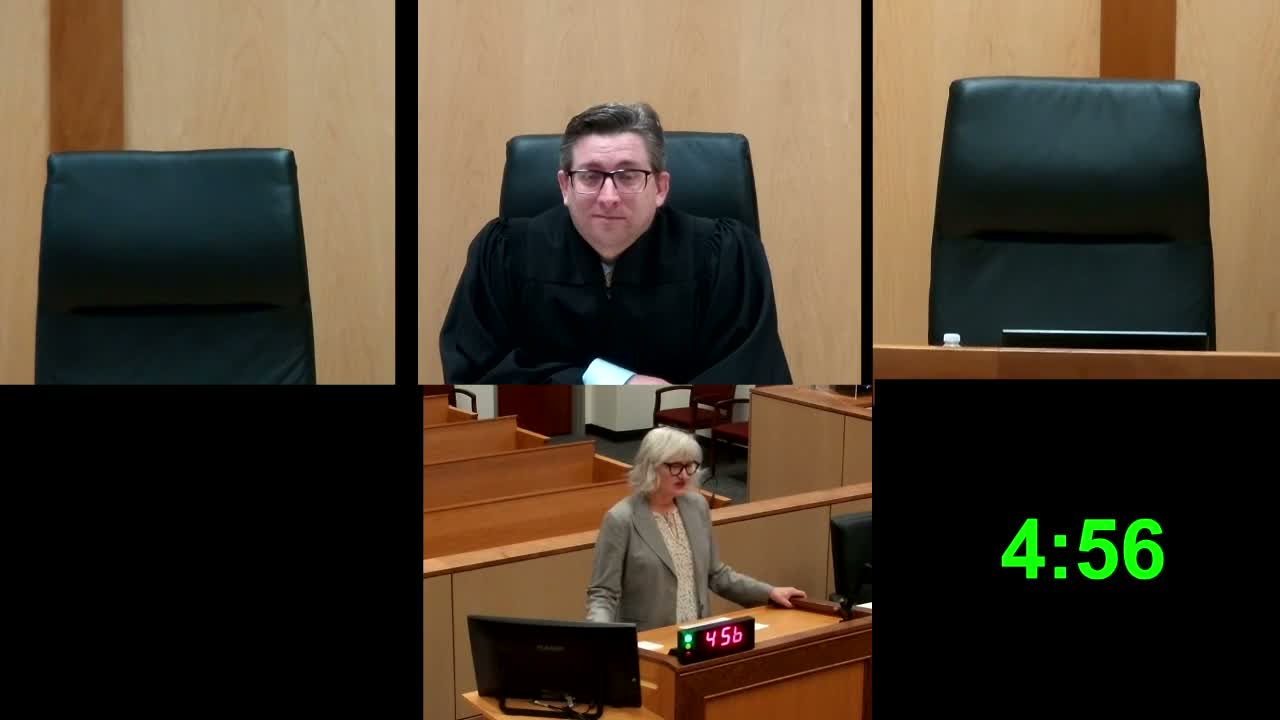
Court of Appeals hears whether children must be allowed at dependency hearings
Loading...
Summary
At an April 8, 2026, argument in Division 2 of the Washington Court of Appeals, counsel for the child argued the juvenile court improperly excluded the child SC without a Matthews due-process analysis and urged a published framework; the state urged denial, saying the trial court's protective measures were sufficient.
Division 2 of the Washington Court of Appeals heard oral argument on April 8, 2026, over whether children have a constitutional right to be present and to participate in their own dependency hearings. Commissioner Carl Bridal presided.
Jody Baffin, counsel for the child SC, told the court, "Do children have the right to be present for their own dependency hearings?" and argued the juvenile court excluded SC without conducting the procedural due-process analysis required under Matthews. Baffin said the trial court relied on subjective and inapplicable factors and that a published appellate decision providing a due-process framework would help trial judges statewide.
Bailey Kleinman, assistant attorney general for the Department of Children, Youth, and Families, urged the court to deny review. "This court should deny SC's motion, for 3 main reasons," Kleinman said, summarizing the department's position that the trial court used a sufficient protective framework (described in argument as "Bone Club plus"), that further proceedings are not rendered futile, and that SC's statutory waiver argument under RAP 2.3(b)(3) fails.
The petitioner's central claim is that the juvenile court failed to apply a Matthews v. Aldridge/Matthews v. Eldridge due-process balancing test before excluding SC from proceedings and that, when exclusions are considered, the court must make fact-based findings and attempt mitigation. Baffin argued the record lacked direct expert evidence establishing a causal link between SC's attendance and any disruptive behavior and relied in part on hearsay from foster-placement sources. She asked the appellate court to publish guidance for trial courts rather than leave the matter to patchwork practice.
Kleinman responded that the trial judge considered SC's participation history, observed behavior, filings from caregivers and the guardian ad litem, and available alternatives, and that the record supported the court's judgment. She emphasized the government's interest in avoiding further harm to children in court settings and noted statutory provisions that authorize exclusion in particular contexts. Kleinman also said SC's attorney had opportunities to explain proceedings to the child and that the court invited SC back into the courtroom after legal argument when appropriate.
During argument, a panel member questioned whether the facts necessary for a Matthews-style analysis were undeveloped on the record and pressed counsel on whether expert testimony is required to justify exclusion. Baffin acknowledged she sought a framework rather than an absolute rule and urged that courts require a factual showing—ideally expert evidence—if exclusion is premised on risk to a child's well-being.
The court took the matter under advisement and said it would issue a ruling as soon as possible. No opinion or published guidance was issued at the hearing.