Get Full Government Meeting Transcripts, Videos, & Alerts Forever!
Get email alerts on the Property Tax Administration topic
No spam. Unsubscribe anytime.
Douglas County staff outline property tax administration, say incentives add significant staff workload
Summary
County finance, appraisal and treasurer staff reviewed property tax administration Feb. 25, saying the tax team issued nearly $279 million in statements last year and that incentive programs such as NRAs, RHIDs and TIFs require substantial manual work and cross-department coordination.
County staff gave Douglas County commissioners a detailed briefing Feb. 25 on the property tax billing cycle and the county’s role administering a range of tax-incentive programs, saying the work touches every department and can be time-intensive.
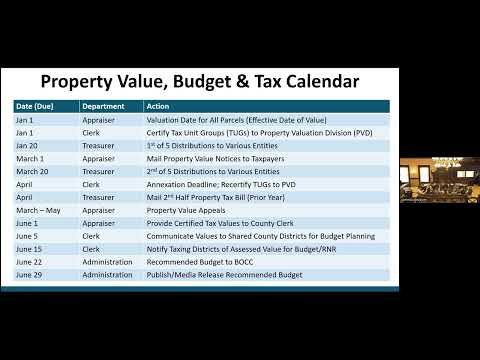
Brooke Sauer, finance manager in county administration, said the tax team issues tax statements for every taxing jurisdiction and that “just this past November, the tax team issued tax statements totaling nearly $279,000,000.” Sauer and other staff described a complex calendar of valuation certification, billing and levy-setting that overlaps with other budget work.
The briefing focused on how the clerk, treasurer and appraisal offices share tasks and respond when state law or legislation changes. County appraiser Brad Eldridge emphasized timing constraints: the county typically receives state-appraised utility values around June 1 and must incorporate them quickly into local calculations.
Eldridge walked commissioners through incentive programs the county administers for cities, including neighborhood revitalization areas (NRAs), reinvestment housing districts (RHIDs), tax increment financing (TIF) districts, industrial revenue bonds (IRBs), payment-in-lieu-of-tax arrangements (PILOTs) and economic development exemptions (EDXs). He said NRAs and RHIDs are calculated parcel-by-parcel and that some NRAs last 10–22 years depending on the project.
Staff described the administrative burden. Eldridge said setting up RHIDs this year required “well over 200 hours on setup” to adapt systems and track calculations, and that many program distributions still require manual calculations. Candace Norman, an accountant in the treasurer’s office, described doing distributions and taking out administrative fees before routing money to the county general fund.
Commissioners and staff discussed who pays for that work. Eldridge said the county does not currently collect a setup fee for RHIDs and that only NRAs presently carry an administrative fee. He outlined NRA fee history: older plans were charged $1,000 annually, fees were later adjusted to $500, and a tiered structure established in 2020 reached as high as $2,000. Eldridge said the fee does not fully cover staff costs and that staff may ask state officials whether a fee for RHID administration is allowable under statute.
The presentation also noted software and staffing challenges. Staff said the state-provided appraisal software is used statewide but not all counties use the same tax-billing systems, forcing local workarounds and manual calculations for some incentive distributions.
Why it matters: these programs shift property tax revenues and require sustained tracking over many years. Commissioners raised the policy question of whether incentive programs generate enough new tax base to justify the staff time and temporary revenue reductions, and staff said that answer varies by program and will take years of data to assess.
The work session recessed without any formal action; the county’s 5:30 p.m. business meeting was scheduled to take public comment and consider decisions later in the evening.