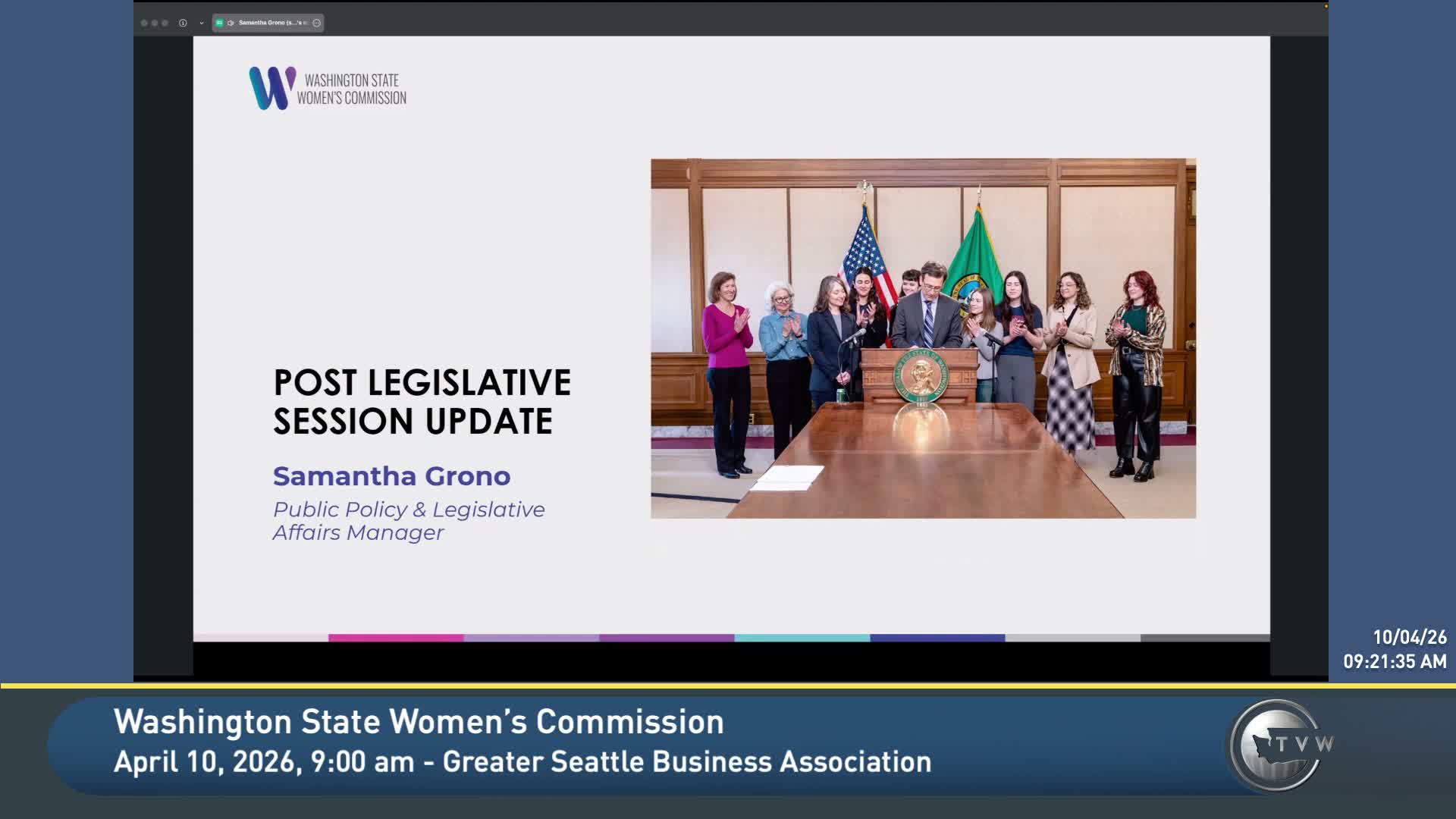
Commission hears post‑session update as lawmakers warn of budget strain, childcare and Medicaid risks
Loading...
Summary
Representative Taylor told the Washington State Women’s Commission that the next budget cycle remains tight, highlighting childcare funding, protections for victim services and risks to Medicaid‑funded home‑and‑community services; Representative Guy urged attention to rural infrastructure and community college closures.
Representative Taylor told the Washington State Women’s Commission on March 26 that the state’s budget remains under significant strain after the short legislative session and that the commission should prioritize programs that ‘‘support women and families.’' She cited the working families tax credit, distribution of childcare funds and the bipartisan protection of the 340B drug‑pricing program as session outcomes.
"Our budget is our values," Rep. Taylor said, adding that long‑term financing pressure has led lawmakers to consider a range of options — including an initiative often described in the session as the "millionaire's tax" — and that some of those efforts may face court challenges.
Taylor warned that federal changes under HR 1 and other federal proposals threaten Medicaid‑funded home and community‑based services and said the state is working to fill gaps and protect victim services funded by VOCA. She also described a pilot to provide free public transportation for community college students in Western Washington served by ORCA regional transit, and said the pilot will begin in select areas before any expansion.
Rep. Guy, joining the meeting, urged the commission to consider the distinct needs of rural Eastern Washington. He described recent community college closures and the loss of local health‑care services that leave residents without timely access to care: "We can't even get those kids a community college where they can learn nursing, radiology, dental hygiene," he said, urging investments in water, power and local jobs to rebuild economic opportunity.
Why it matters: Commissioners said these fiscal constraints will shape the commission’s interim agenda and recommended focusing limited staff and volunteer capacity on one or two high‑impact priorities (for example, childcare access or AI/data privacy from a public‑safety lens) in order to influence implementation planning.
What happens next: Commissioners agreed to collect committee priorities over the coming weeks and return in June/July to recommend a focused set of policy priorities for the interim. The governor’s office representative said agencies are already developing budget and implementation plans and that the administration is exploring delayed implementation requests where federal timelines impede practical rollout.
Sources: Remarks and Q&A by Rep. Taylor and Rep. Guy during the commission’s post‑session briefing.