Lifetime Citizen Portal Access — AI Briefings, Alerts & Unlimited Follows
OIR director Hashimi briefs Seattle council on 2026 short session: budget trade-offs and local wins
Loading...
Summary
Mina Hashimi, director of the Office of Intergovernmental Relations, told the Seattle City Council that the 2026 short session ended on sine die and produced several Seattle priorities and capital grants but left the state budget balanced largely with one-time fixes and account transfers that will have local fiscal impacts.
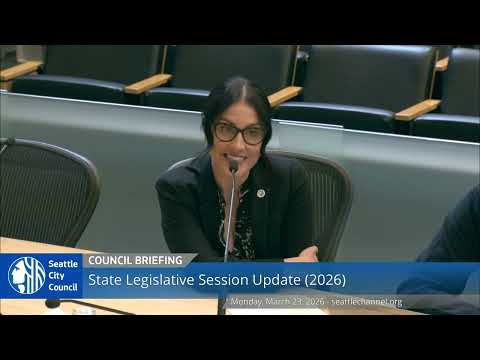
Mina Hashimi, director of the city's Office of Intergovernmental Relations, told the Seattle City Council on March 23 that a fast-moving 60-day legislative session concluded with a mix of wins for city priorities and budget choices likely to affect local governments.
Hashimi said the governor's proposed plan sought to close roughly a $2.3 billion shortfall and that the enacted operating budget — she cited a $79,400,000,000 figure for the state's operating plan — relies heavily on one-time solutions, reserves and account transfers. "The reality of the shortfall quickly consumed legislative discussions and ultimately the state's $79,400,000,000 operating budget relies heavily on 1 time fixes," she said.
OIR staff walked council members through Seattle-specific outcomes. The supplemental capital budget included several direct awards to the city: $1,500,000 for a dirt-to-turf conversion at Lower Woodlawn Park softball fields, just over $2,000,000 for decarbonization planning at Fisher Pavilion, roughly $6,000,000 to acquire a site in Montlake for an affordable homeownership project and more than $7,000,000 to Mercy Housing for the Lake City community center redevelopment, OIR reported.
On revenue, OIR described Senate Bill 6346 (the so-called "millionaires' tax") as imposing a 9.9% tax on income above $1,000,000 beginning in 2028 with receipts starting in 2029; OIR said 5% of that revenue is designated for the Fair Start for Kids account and that the package includes a $140,000,000 placeholder for universal free school meals in the 2027'29 period. "A big part of discussion this session was where the revenue would go to," OIR said.
OIR also flagged policy changes that could reduce some local receipts. Asked by Council member Rink about the reversal of recent sales-tax changes, OIR said previous session legislation that broadened sales-taxed services will be repealed beginning Jan. 1, 2029, producing net losses for some local governments and transit agencies; OIR cited preliminary local estimates including roughly $175,000,000 over two years for King County and as much as $100,000,000 per year for Sound Transit.
Council members pressed OIR on program cutbacks and practical local impacts. When Council member Foster asked about an approximately $91,500,000 reduction to the Working Connections child-care program, OIR said the reduction applies statewide for the remainder of the biennium and results from changes to attendance, reimbursement and enrollment-payment structures; OIR offered to follow up with department-level impact analyses for the city.
Hashimi and her team also highlighted public-safety and housing bills, including measures on toxicology testing for DUI proceedings, restrictions on certain 3D-printed firearm components and changes to rules for social-housing developers and condominium liability. OIR noted some Seattle priority bills did not pass this session and will be carried into the next biennium.
The briefing ended with OIR offering to provide the council a full slide deck and a bill tracker listing bill status (signed, awaiting signature or vetoable) and requested follow-up analysis on localized fiscal impacts and compliance deadlines. The council asked OIR to return with more granular department-level impacts in the coming weeks.