Get Full Government Meeting Transcripts, Videos, & Alerts Forever!
Get email alerts on the Ag Income Test topic
No spam. Unsubscribe anytime.
Gorge commission committee to review agricultural-income test, add loan programs and workforce training to work plan
Summary
The Columbia River Gorge Commission—conomic vitality committee agreed to add a formal review of the agricultural income test and related profitability policy to its future work plan and asked staff to gather baseline data; commissioners also supported exploring loan programs, workforce training and urban-area economic development supports.
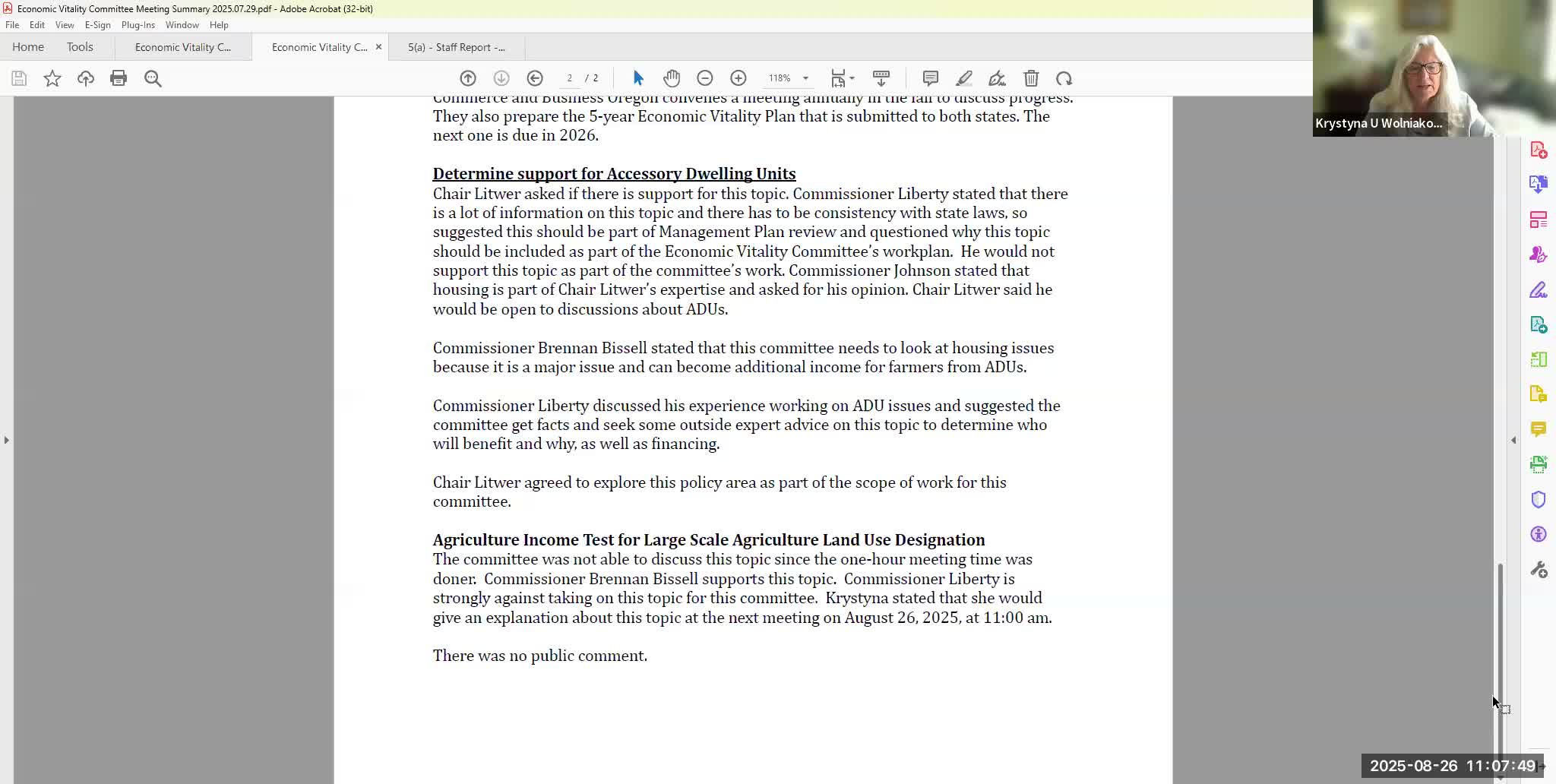
The Columbia River Gorge Commission—conomic vitality committee on Monday agreed to place a review of the commission gricultural income test and related profitability policy on its future work plan and asked staff to gather data and outside expertise before making any recommendation.
Chair Littler opened the one-hour meeting by noting attendance issues but allowing the committee to proceed without a formal vote. The executive director gave a brief history of the income test, saying it was part of the National Scenic Area management plan and that the committee dopted a gross-income threshold of $80,000 in the 2020 plan as an inflation-adjusted equivalent to $40,000 in 1991.
"This is gross income and not net income," the executive director said. "So it doesn't mean that you have to have $80,000 of profit." The director said the $80,000 figure was derived by applying a consumer-price-index inflation calculation to the earlier $40,000 standard.
Commissioners debated the test's purpose and whether the CPI adjustment is the right method. "It's a farm business test for the purpose of obtaining a profit, not that you require having a profit," Commissioner Robert Liberty said, urging the committee to consult Census of Agriculture data and other local measures. Liberty said many local farms report only modest gross or net returns and recommended staff provide baseline figures on how many houses and farms currently exist in agricultural zones.
Commissioner Brenda Bissell cautioned against speculation about residents' circumstances and argued the income test is a substantive agricultural policy rather than a real-estate restriction. "The ag income test has to do with how much money you are making off of your land, which then has to do with whether you can build a house there or not," she said, and asked for historic and current maps showing which parcels were designated as agricultural when the National Scenic Area was formed and which are designated now.
Members also discussed related topics they want staff to research and bring back: whether existing loan programs (referenced examples from statewide partners) could be targeted to rural households, workforce-training partnerships with community colleges, and urban-area economic development supports the commission could convene or recommend. Several commissioners noted the commission's limited regulatory authority inside urban areas but said it can still convene partners and recommend funding.
The committee did not take any formal votes. Chair Littler said staff would circulate the 2023 staff report that documents how the income test was calculated and asked the executive director and volunteers among the commissioners to prepare briefing materials for the next meeting.
The committee opened the agenda for public comment and, finding no speakers, closed the meeting after roughly an hour, with the income-test review set for fuller discussion at the next convening.