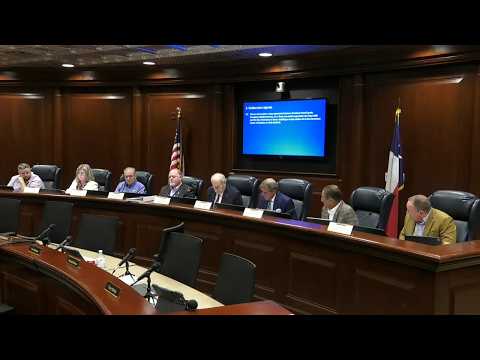
Granbury adopts ordinance adding standards for data centers and power generation after wide public concern
Loading...
Summary
After a lengthy public hearing in which residents warned about noise, air and water impacts, Granbury city officials adopted Ordinance No. 26‑14 to add definitions and supplemental standards for data centers and power generation; staff said the change is a proactive, amendable framework rather than approval of any specific project.
Granbury — The City Council voted to adopt Ordinance No. 26‑14 to amend Articles 4 and 12 of the city zoning code, adding definitions and supplemental standards for data centers and power generation after a public hearing that drew more than a dozen speakers who urged stricter limits on size, enforcement and environmental impacts.
City staff presented the amendment as a planning measure to create clear expectations ahead of any future project. Cody Nolan, the director of Community Development, described the changes as additions to land‑use definitions and the industrial land‑use table and said the new Supplemental Standard 43 addresses "the sound, the height, the visual buffers, the best practices, battery storage, visual buffers, construction management, as well as traffic plans" and also includes "light pollution protections for night sky protection." Staff recommended approval.
Shay Hopkins, the city's director of economic development, framed the item as proactive policy rather than approval of a particular proposal. "The item before you tonight is not about approving a specific project. It's about planning ahead," Hopkins said, adding the goal is to "require appropriate protections, and better align any potential development with our community's expectations."
Nut graf: Residents and local officials did not focus on a single technical detail; instead speakers repeatedly pressed for clearer enforcement, numerical limits and stronger environmental safeguards — including questions about noise measurement methods, air emissions, water use and visual buffers — and urged the council to delay or tighten the proposed language before allowing these uses by right.
Community concerns and technical points raised Residents and officials raised a range of concerns during the public comment period. Several asked that data centers or large power plants receive special use permits rather than being permitted by right; others urged explicit numeric limits and more frequent review cycles.
Shannon Wolf urged restrictions on ownership and called for more evidence: "no owner of a data center should ever be from outside The United States," she said, and cited a recent study she described as showing temperature effects up to 16 degrees Fahrenheit around large facilities. Several commenters challenged the technical bases of provisions in the draft ordinance and asked staff to tighten vague language.
Craig Jackson, who lives adjacent to the Knox Ranch property discussed by multiple speakers, questioned the 45‑decibel noise reference in the draft and asked for specific monitoring protocols: "Let's define what that 45 decibels will read," he said, and recommended adding C‑weighted decibel monitoring or one‑third‑octet band analysis and clearer low‑frequency vibration metrics.
Several speakers flagged air quality and permitting. Hood County Commissioner Nanette Samuelson said she did not see decibel limits, decommissioning requirements or explicit penalties for noncompliance in the draft, and asked whether local water systems and roads would be affected by construction and operations. Danny Lakey urged requiring special use permits for any power plants or hyperscale data centers and to ensure new plants meet LAER (Lowest Achievable Emission Rate) standards given Hood County's ozone‑nonattainment status.
Others asked for concrete numeric protections: Carolyn Faubert recommended mirroring the county's 10% property coverage limit; Cindy Highsmith and others urged modeling the cumulative air impacts and adding wastewater limits and public notification for projects that otherwise could proceed under standard state permits.
Staff response and commission action City staff and officials responded that many of the enforcement and technical issues raised are addressed elsewhere in the code and that the amendment is intended as an add‑on to existing regulations; staff also said they would review the air‑quality and related technical concerns raised at the hearing. "Many of the things that were mentioned are covered in other parts of the ordinance, and the enforcement is also covered in the rest of the ordinance," a staff speaker said.
The Planning & Zoning Commission voted to recommend approval of the amendment, with a recorded vote reported as five in favor, four opposed and one recorded separately; the chair declared the motion passed and forwarded the recommendation to City Council.
City Council then considered the ordinance. A council member moved to adopt Ordinance No. 26‑14, a second was recorded and the presiding official said he "heard no nays," after which the ordinance was adopted on the council floor.
What the ordinance does — and does not — do The adopted language adds two defined land‑use categories (data centers and power generation) to the city's land‑use definitions and includes a supplemental standard intended to guide siting and mitigation. City officials emphasized this action does not approve any specific site plan, permit or construction; it creates a regulatory framework staff can amend or strengthen later when an applicant files one or more concrete proposals.
Residents pressed for specific next steps: more explicit enforcement language, defined penalty structures, clearer decibel and monitoring standards, caps on water use, stronger visual buffers, higher decommissioning bonds and a requirement that certain projects obtain special use permits or public referendums. City staff said they would compile the community input and review where specific technical standards need tightening.
Claimed impacts and requests for follow‑up Speakers asked the council to consider a range of technical studies and regulatory changes before allowing large‑scale facilities: noise monitoring protocols (including low‑frequency measures), air modeling and incremental NOx caps, limits on impervious coverage, detention‑pond siting standards, and guarantees for public notice and third‑party compliance verification. Several asked that the council either deny the amendment or postpone implementation to allow staff to incorporate these changes.
Next steps Ordinance No. 26‑14 is now part of the city zoning code as an amendment to Articles 4 and 12. Staff said they will review the written comments and suggested technical edits submitted during the hearing and consider further amendments if necessary when specific project applications are filed.
The council's action establishes a municipal standard for how to handle prospective data centers and power generation proposals but does not grant permits or site approvals for any named development.