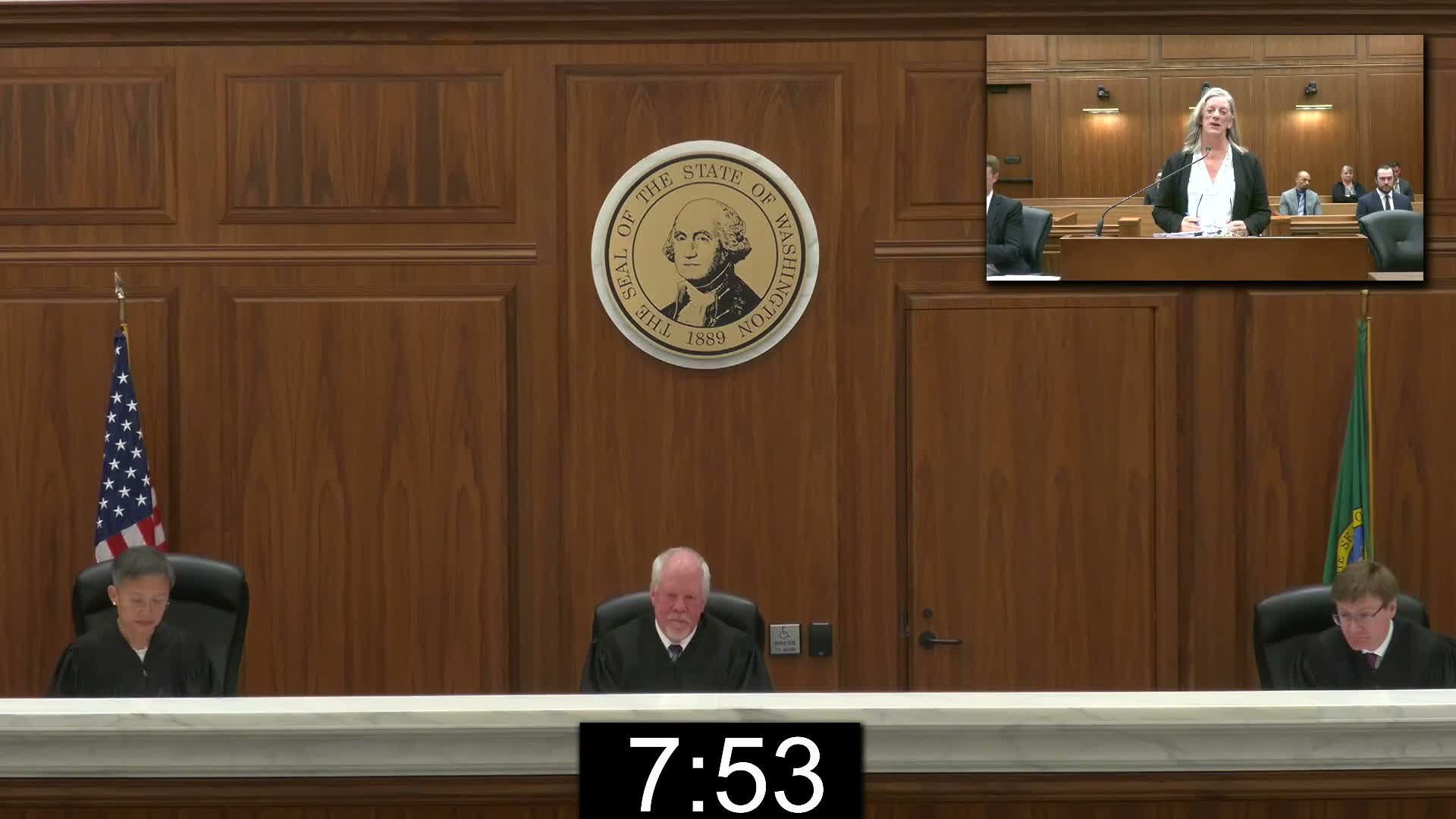
Panel weighs whether trial judge erred in excluding defense experts in Wilson v. CIVA Logistics
Loading...
Summary
At oral argument in Wilson v. CIVA Logistics, appellants' counsel said the trial court excluded two key defense experts without making required Burnett findings and asked for a new trial; appellee counsel said the record does not show what the experts would have said and any error was harmless. The dispute also involves hearsay rulings and a post-trial remittitur tied to an $8.5 million verdict.
Appellate oral argument centered on whether the trial court properly excluded defense expert testimony before an $8.5 million jury verdict and whether the court erred in granting a partial remittitur.
Janie Freeman, attorney for appellants CIVA Logistics, Emerald Transport and driver Daniel Chavez, told the panel that the trial court applied Burnett v. Spokane Ambulance but did not make the three required findings—willfulness, prejudice and consideration of lesser sanctions—before excluding two defense experts (an economist and a vocational-rehabilitation expert). "The Burnett standards applied to these decisions," Freeman said, and she argued the wholesale exclusions left the defense without expert testimony to rebut the plaintiff's economic and general-damages evidence.
Nate Roberts, counsel for respondent Miss Wilson, urged the court to vacate and reverse only the trial court's partial remittitur and otherwise affirm. Roberts said the appellate record provides no clear proffer of what the excluded experts would have said and that, in several respects, testimony and proffers that the defense placed before the court were allowed. "This court, like Judge Rogers, remained completely in the blind as to what those experts were going to say," Roberts told the panel, arguing that any limited admission error was harmless in light of evidence the jury heard.
The panel pressed both sides on the sufficiency and timing of disclosures. A panel member asked whether listing experts' names and subject areas—without stating their substantive opinions—could be treated as willful nondisclosure when those opinions were provided to counsel only days before trial. Freeman responded that local practice and the Burnett line of cases require clearer proffers and that lesser sanctions (short depositions or a brief continuance) were commonly used instead of exclusion.
Roberts disputed that exclusion was reversible error here, citing the trial record and arguing the jury had other admissible evidence it could use to assess damages (including testimony suggesting additional treatment needs and evidence of roughly $200,000 in past medical bills offered at trial). He also said one contested hearsay statement was never actually offered at trial and that an incident report referenced by appellants was not designated in the appeal record.
Both sides asked the panel to resolve mixed questions: whether the trial judge's statements satisfy Burnett's required findings when the record lacks a detailed proffer of the excluded experts' opinions; whether lesser sanctions would have cured any disclosure deficiency; and whether any exclusion was harmless given other evidence the jury considered. Appellate resolution will determine whether the partial remittitur stands, whether a new trial is required, or whether the trial court's rulings are otherwise affirmed.
The panel did not announce a decision at argument; the next step is a written opinion from the court.