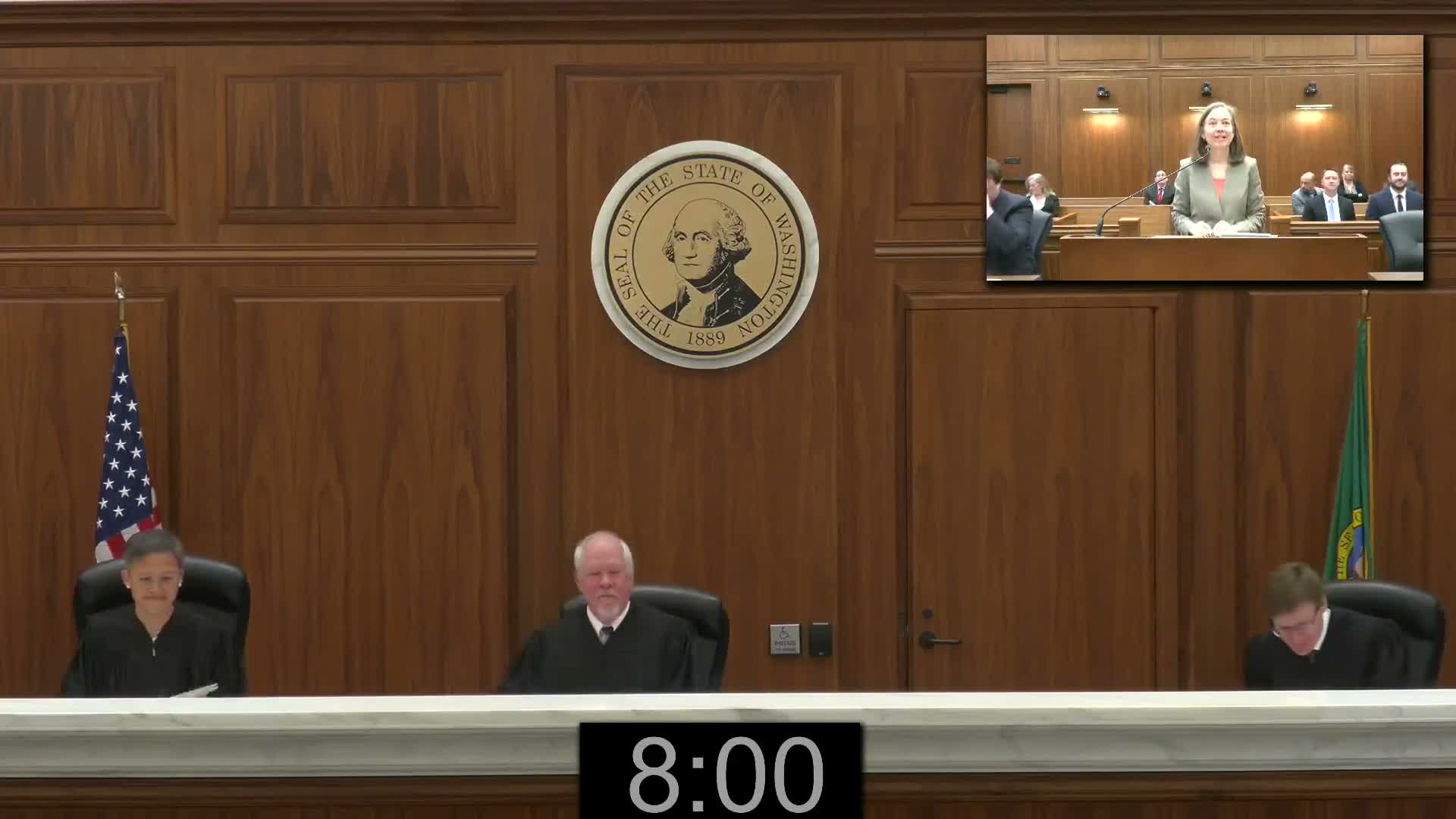
Appeals panel weighs whether trial court improperly admitted other‑acts evidence in State v. Russell
Loading...
Summary
At oral argument in State v. Russell, defense counsel asked the appellate court to reverse and remand for a new trial, saying the trial court failed to perform the four‑step ER 404(b) analysis and denied mistrial motions after witnesses violated pretrial rulings; the state countered that any error was harmless or waived.
An appellate panel in Other Court heard argument over whether the trial court abused its discretion by admitting evidence of other bad acts and by denying mistrial motions in State v. Russell.
Defense attorney Lila Silverstein told the panel that "Mister Russell asked this court to reverse his convictions and remand for a new trial because the trial court abused its discretion by denying mister Russell's motions for a mistrial after state's witnesses violated a pretrial ruling excluding evidence of other bad acts." She argued the trial court admitted testimony about two specific prior incidents (one described in the record as indecent exposure and one redacted in the transcript as involving a child) without completing the four steps required under ER 404(b) and without a limiting instruction.
Silverstein told the court the judge at trial had conflated the ER 404(b) analysis with a Petrich inquiry about instances of charged offenses and had not made the threshold finding whether the uncharged events actually occurred, a predicate she said is required by controlling law. She urged that because the trial court "didn't determine any of the 4 steps," reversal and a new trial were appropriate.
The state, represented by Gabriel Jacobs, disputed that relief was warranted. Jacobs said the appellate court can and does assess prejudice and argued the ER 404(b) issue may be waived or, in any event, that any error was harmless because the jury's verdict turned on the core complainant's credibility. "Ultimately, the reason why it's harmless is because this is all based on [the complainant's] credibility," Jacobs said, adding that the jury received graphic testimony supporting the charged offenses and that the additional instances were, in the state's view, cumulative.
Panel members pressed both sides on two recurring questions: whether the defense unambiguously preserved a four‑step ER 404(b) objection at trial, and whether an appellate court may perform the factual components of the ER 404(b) inquiry (including a finding that an uncharged incident occurred) in the first instance or must remand to the trial court for fact‑finding. Judges cited and discussed past appellate decisions, including references made in argument to Griffin, Crossguns, Pirtle and Sublet, and asked whether those cases allow the court to resolve admissibility and prejudice without a remand.
Silverstein emphasized that the record contained at least three instances in which state witnesses violated pretrial rulings, including testimony that the defense said was struck and that the trial court instructed the jury to disregard. She told the panel that because the improper references were highlighted by objections and jury sequestration, they were likely to have heightened prejudice. Jacobs countered that the complained‑of references were raised in opening and closing and through witness testimony but maintained the conviction was supported by the central testimony even without the contested acts.
On remedy, the parties debated alternatives: Silverstein said a full new trial is the appropriate remedy if the ER 404(b) steps were never performed, but she indicated she would accept a remand for a limited evidentiary hearing to allow the trial court to apply the four‑step framework. The panel repeatedly urged clarity on the harmless‑error standard and on whether, in practice, the court should treat the inquiry as asking whether the contested evidence would likely be admitted on retrial.
Argument concluded after extended questioning; the panel did not announce a decision from the bench.
The case centers on appellate limits for reviewing admission of propensity or other‑acts evidence, when such evidence requires a limiting instruction, and what remedy—remand for a hearing or a full retrial—is appropriate when a trial court's ER 404(b) analysis is incomplete or absent.