Get Full Government Meeting Transcripts, Videos, & Alerts Forever!
Get email alerts on the Energy Contracts topic
No spam. Unsubscribe anytime.
IMEA officials urge Red Bud to approve long-term power contract to lock in lower projected rates
Summary
IMEA representatives told Red Bud officials a 20-year contract would smooth long-term costs, and described portfolio additions (solar, wind) and a projected supply-cost drop when IMEA bonds retire in 2035. Council asked questions and requested contract documents for review.
IMEA officials presented a detailed case for a 20-year power-sales agreement with Red Bud, arguing that longer contracts will reduce volatility and avoid steeper short-term prices as the region transitions generation resources.
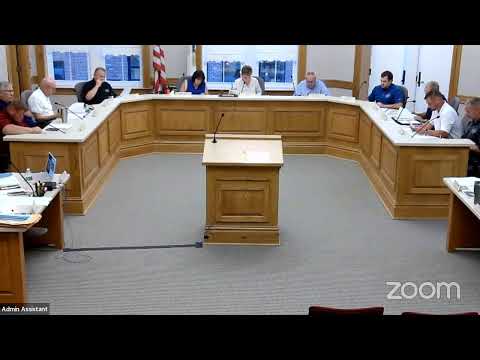
At the Public Works Committee meeting IMEA president and CEO Kevin Gayden said IMEA's current contract expires in September 2035 and the agency is proposing a successor term running roughly Oct. 1, 2035, through May 2055. "We're one of the best, financially fit, electric utility entities in the state right now," Gayden said, adding that IMEA's annual debt service is about $89,000,000 against a budget of roughly $355,000,000 and that paying off bonds in 2035 should produce a marked drop in power-supply cost.
Sean McCarthy, IMEA manager of electric operations, framed the issue around three principles—affordability, reliability and sustainability—and showed a chart separating IMEA's controllable supply costs from transmission pass-throughs. McCarthy noted IMEA's growing renewable mix, citing a 25-MW Big River solar farm and other solar and wind projects the agency is adding to its portfolio.
Gayden described anticipated resource retirements driven by state policy and plant economics; he said about 45% of output from Prairie State will need to be reduced by the middle of 2038 under the Climate and Equitable Jobs Act, and that replacement resources will take years to develop. He argued a longer-term purchase-power agreement lets members secure supply at substantially lower per-megawatt-hour prices than short-term purchases: IMEA shared indicative bids showing around $65/MWh for a 20-year PPA versus roughly $95/MWh if that exposure were compressed to 10 years.
Council members asked about ownership versus purchase agreements, whether IMEA would issue debt to build new solar, and how the agency would use federal tax credits. Gayden said many of the near-term projects are structured as purchase-power agreements (payment obligations, not municipal debt) because tax-credit rules today favor taxable developers; he said IMEA is working with other public-power utilities and federal agencies to open options for public entities.
IMEA also proposed modest increases to member capacity payments: Gayden said IMEA is considering raising the guaranteed minimum capacity payment to about $3.20 per kilowatt-month no later than 2035 and incrementally increasing production compensation from $1.20 to $2.20 over five years, which would raise payments to cities that operate local generation.
Council members asked for the contract documents and a sample ordinance. Gayden said IMEA provided the contract and a sample ordinance and will make staff available to answer follow-up questions. The committee did not take a final vote on Red Bud joining the proposed agreement during the session; city staff said they will review the contract, confer with counsel, and bring the item back for an ordinance vote if the city wishes to proceed.
Provenance: The presentation and Q&A began in committee when the Public Works Committee opened the IMEA item and continued through a series of financial and technical questions; IMEA provided contract drafts and a sample ordinance for the city to review as a next step.