Defense says counsel violated Klungel’s McCoy right; state urges denial
Loading...
Summary
At oral argument, defense attorney Dominica Confortino told the Michigan Supreme Court that trial counsel conceded Richard Klungel’s guilt over his express insistence on innocence under McCoy v. Louisiana and asked for reversal and a new trial; the state argued Klungel failed to assert factual innocence and urged the court to deny relief.
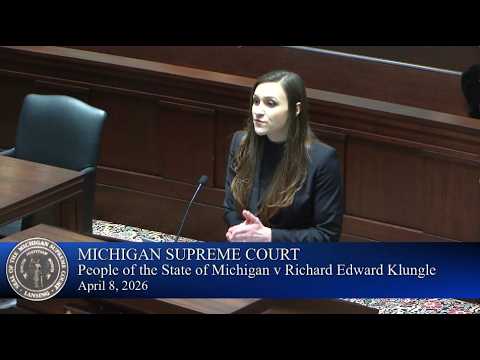
Dominica Confortino, representing Richard Klungel, told the Michigan Supreme Court that trial counsel improperly conceded Klungel’s guilt despite Klungel’s repeated insistence that he was not guilty, arguing the concession violated the Sixth Amendment right recognized in McCoy v. Louisiana. “The rule from McCoy is clear and it comes directly from the Sixth Amendment,” Confortino said, arguing the attorney “may not concede the client’s guilt.”
Confortino asked the court to reverse a published opinion below and remand the case for a new trial on all three counts, saying the record shows the defendant repeatedly asserted innocence before and during trial and that the attorney’s concession was made without consulting Klungel. She told the justices that the trial record contains testimony from both Klungel and his trial lawyer admitting the disagreement and that the lower courts misapplied Nixon-based ineffective-assistance analysis in place of McCoy’s structural-rule protection.
Nick Johnson, arguing for the People, countered that McCoy presumes a defendant must do his part to assert factual innocence. “Here, Mr. Klungel did none of this,” Johnson said, noting that Klungel told his lawyer he believed he had a right to occupy the property but that a valid eviction order said otherwise. Johnson argued that Klungel’s courtroom testimony admitted defiance of the eviction order and thus undercut any claim of factual innocence that would trigger McCoy relief.
Several justices pressed both sides on how to define McCoy’s functioning rule: whether McCoy protects any defendant who says they want to maintain innocence or whether the court must require an unambiguous, on-the-record assertion of factual innocence to entitle a defendant to remedy. A justice asked whether the record’s communications—or the absence of an on-the-record objection—should determine the outcome; Confortino replied that McCoy does not require a literal in-court procedural objection and that private disagreements or repeated protestations suffice to preserve the right.
The parties also disputed how a concession on a trespass count bears on related resisting-and-obstructing counts. Confortino argued, citing People v. Moreno, that the trespass concession necessarily conceded the lawful-arrest element central to the R&O counts because the charges were linked. The state replied that once Klungel’s testimony established the factual basis (he remained on the property in defiance of an eviction), counsel had little room to argue otherwise to the jury.
Confortino closed by emphasizing McCoy’s broader autonomy protection and asked the court to reverse and remand for a new trial on all three charges. The state urged denial or affirmation of the lower court’s decision. The court took the case under submission and adjourned.