Seaside Planning Commission advances revised comprehensive plan draft, sets path to public hearings
Loading...
Summary
After a detailed line-by-line discussion of state and stakeholder comments, the Seaside Planning Commission asked staff to publish a revised draft and crosswalk showing policy changes, agreed to use the mean higher high water line as the shoreline measurement reference, and directed staff to proceed with a 35‑day notice and June public hearing.
The Seaside Planning Commission on April 6 reviewed a new draft of the city’s comprehensive plan and directed staff to publish a revised public draft, a policy crosswalk, and an executive summary before formal public hearings are scheduled.
Consultant Scott of 3j Consulting told commissioners the draft comp plan consolidates the future land‑use map and zoning map, reflects two years of outreach and a steering‑committee process, and incorporates agency comments received from the state Department of Land Conservation and Development (DLCD). He said the draft now includes chapter‑level specialist reviews and will be released with a final community survey and a public outreach window prior to adoption.
Why it matters: The draft will be the legal basis guiding Seaside’s land use, hazard mitigation, coastal protections and infrastructure policies for years. Commissioners emphasized transparency and asked staff to document where policies were added, changed or left unchanged so the public can see how comments were handled.
Commission requests and staff responses
Commissioners repeatedly asked for a concise ‘‘crosswalk’’ (Excel matrix) that tracks the existing comp plan language against the proposed text and explains why particular state or stakeholder comments were accepted or not. Scott agreed to produce that matrix and an executive summary listing actionable policies and goals.
On public outreach and schedule, Scott and staff said the city must provide at least 35 days’ public notice under the PAPA (post‑acknowledgment plan amendment) process and mail notice to property owners; with those timing constraints staff said a June public hearing is likely if the revised draft is ready in the coming weeks.
Shoreline setbacks and measurement standard
Commissioners debated how to define where shoreline setbacks should be measured from. After technical discussion—covering surveyor methods, vegetative lines, and existing local practice—the commission reached a consensus to use the mean higher high water line as the official measurement reference for shoreline setbacks. Scott and staff said the comp plan will identify the measurement point while the zoning code or later ordinance updates will set the numerical setback distances and implementation details.
Hazards, impaired waters and related policies
DLCD and other reviewers flagged items tied to the county Natural Hazard Mitigation Plan (NHMP), total maximum daily load (TMDL) obligations for the Canakim River, and estuarine protections. Commissioners and staff agreed the comp plan should reference and support the NHMP and other state/federal plans, and to add targeted policy language where Seaside needs city‑specific actions. On water‑quality obligations (TMDLs), staff cautioned that state and federal agencies set technical measurements, but said the comp plan could require applicants to demonstrate compatibility with load‑reduction obligations or to consult appropriate agencies.
Infrastructure and open‑space policy direction
Discussion covered whether to require open space when new developments exceed a density threshold. Commissioners generally favored a comp‑plan level policy that triggers open‑space requirements for developments of more than five dwelling units while leaving quantification and implementation to the zoning code and upcoming middle‑housing code updates. On utilities and resilience, the commission asked for higher‑level language encouraging seismic upgrades and undergrounding utilities ‘‘when feasible’’ and to consider incentives or local improvement districts for costly retrofits.
Action taken: agenda motion tabled
The commission moved, seconded and approved a voice motion to table an agenda item about minor versus major project modifications until the next meeting; the transcript records a voice vote of "Aye" with no roll‑call tally recorded.
What comes next
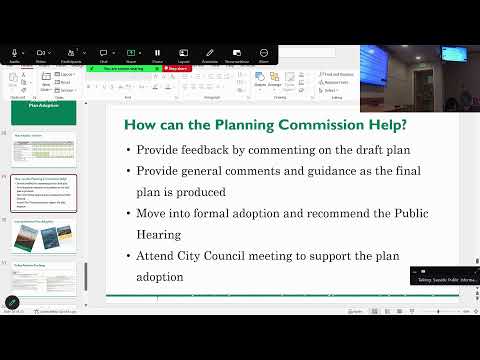
Staff and the consultant will: update the draft to reflect tonight’s discussion, produce the Excel crosswalk and an executive summary, and publish the revised public draft to begin the PAPA notice period. Scott and staff said they will notify the commission when the public draft and matrix are posted so members can prepare for the scheduled June public hearing. The commission also flagged the need to correct typographical errors in the draft participant list and requested better in‑document referencing (glossary/index) to help readers follow DLCD comments.
Quotes
"We're not changing anyone's current zoning. It's just cleaning up several different versions of what the zoning map was between what the county had, the state had, and what the city had," Jeff Florey, city staff, said while explaining the map cleanup process.
"We have a draft comp plan with all those pieces, and also the land use map," Scott of 3j Consulting said, describing the consolidated map that will serve as both the comp plan and zoning reference.
Closing and procedural note
Commissioners asked staff to return with the crosswalk and revised draft in the coming weeks; staff confirmed a 35‑day PAPA notice is required before hearings, making late May/June the likely window for the first public hearing. The commission adjourned after briefly discussing open seats and future attendance for quorum.
Sources: Audio/transcript of the Seaside Planning Commission meeting (April 6, 2026 draft transcript).