Get Full Government Meeting Transcripts, Videos, & Alerts Forever!
Get email alerts on the Public Communications topic
No spam. Unsubscribe anytime.
Students, residents ask City Council for event safety, habitat and anti‑hostile‑architecture measures
Summary
At the noon public communications slot, students and residents urged the council to adopt pedestrian‑flow signage at large events, remove hostile architecture that deters people experiencing homelessness, restore riparian habitat at Lady Bird Lake, and protect ash‑juniper habitat for the golden‑cheeked warbler.
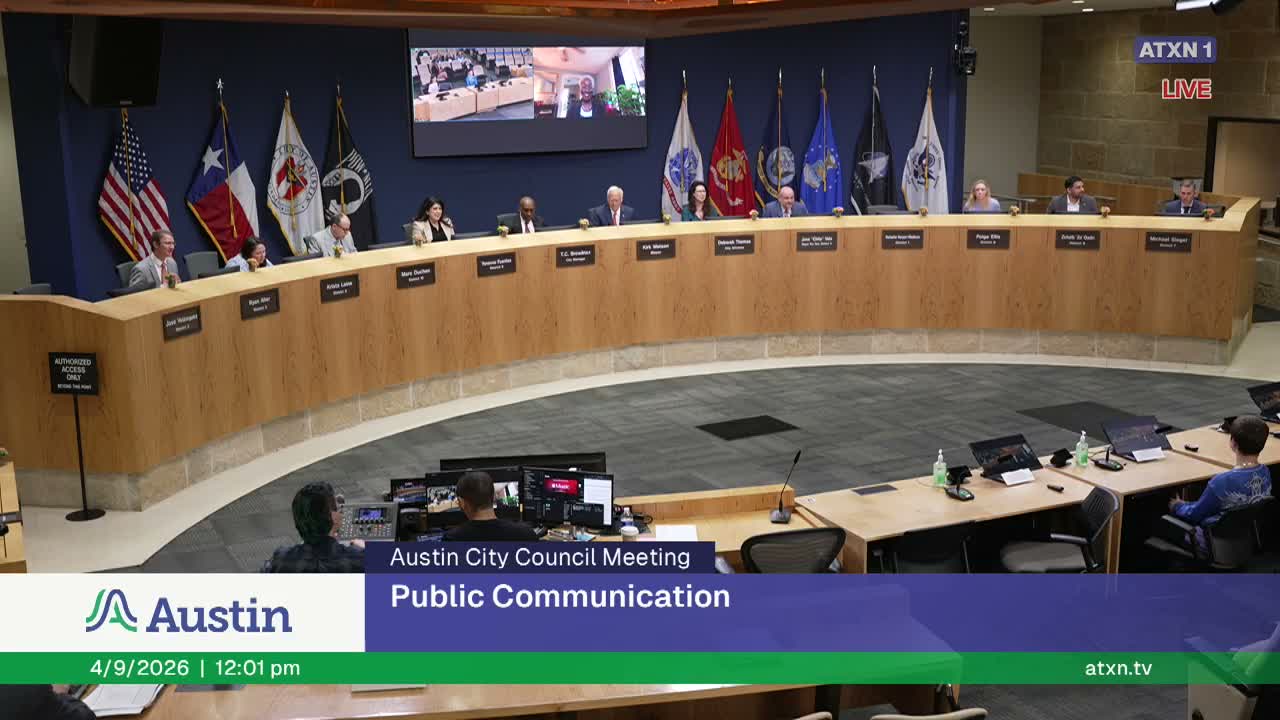
A group of students and community members addressed the Austin City Council during the noon public communications period on April 9, focusing on safety at large events, humane public space design, shoreline restoration and endangered species protections.
Eighth‑grader Brooke Radia asked the council to direct the Austin Center for Events to develop and implement pedestrian directional signage and flow plans for major festivals such as South by Southwest and ACL, citing research that denser multi‑directional flows can increase crowding and reduce individual mobility. "Instead of waiting for a major accident to happen, we should take charge now," Radia said.
Samuel Ratcliffe, in seventh grade, urged removal of "hostile architecture"—bench designs and other features that discourage people experiencing homelessness from using public seating—and said such designs push people away from needed services.
Another eighth‑grader urged replanting native vegetation and improving trash infrastructure around Lady Bird Lake, asserting current maintenance funding for algae management will end this year and asking the council to sustain shoreline restoration.
Student speakers also urged the council to protect ash‑juniper trees and the golden‑cheeked warbler's breeding habitat, noting the species is endemic to Central Texas and depends on mature juniper bark for nesting.
Council members thanked the students and invited photos; the council recessed for a musical performance before returning to afternoon zoning business.